Quick answer
Retrieval-Augmented Generation (RAG) is an architecture where an application retrieves relevant external information and provides it to a language model when producing an answer. Instead of relying exclusively on what the model learned during training, a RAG system can use documents such as product guides, internal knowledge, or recently updated content. Whether an answer is reliable still depends on retrieval quality, permissions, and verification.
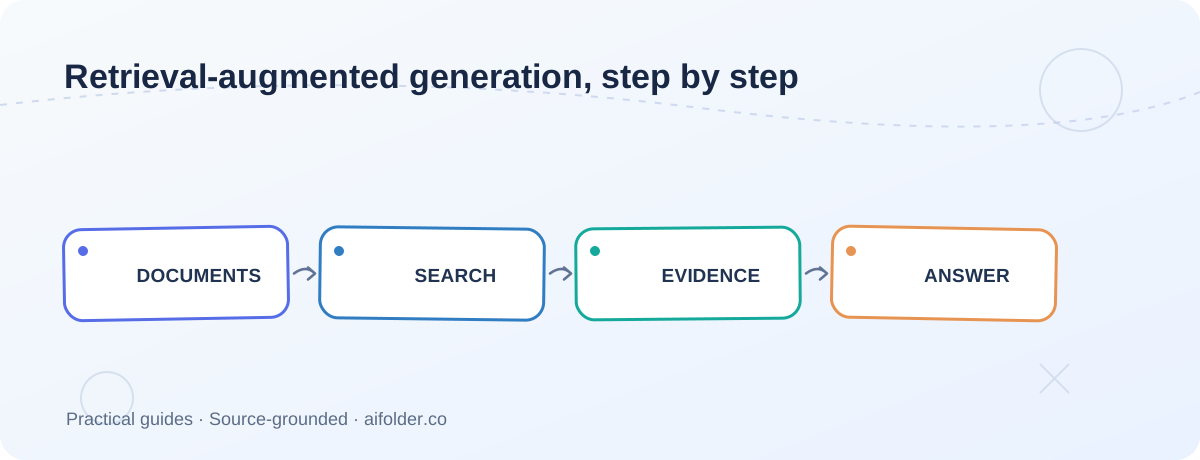
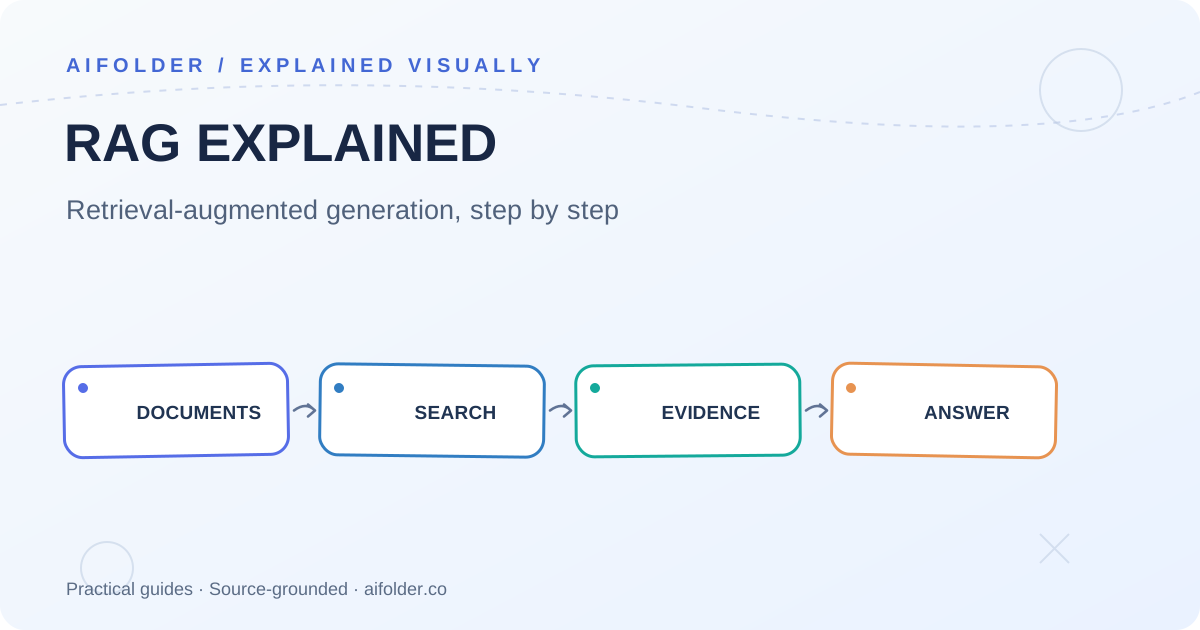
The core RAG flow
- Collect permitted documents from known sources.
- Clean and split documents into searchable chunks.
- Add identifying metadata such as document ID, section, version, and access scope.
- Index those chunks for keyword, semantic, or hybrid search.
- On a question, retrieve the most relevant evidence.
- Provide selected passages and the user's question to a model.
- Return an answer with mapped source references and appropriate uncertainty.
This is a common blueprint, not a requirement that every application use the same database or algorithm.
A simple example
Suppose a software product has a support article describing how exports work. A user asks: 'Can I export a PDF from the free plan?' A generic model may not know the current pricing rules. A RAG-enabled assistant first retrieves the relevant plan documentation and then answers based on the passage. If the source doesn't state whether PDF export is available, the assistant should say so instead of guessing.
Why retrieval matters more than a clever prompt
A prompt like 'Only tell the truth' does not supply missing facts. RAG makes evidence available, but a poorly designed index can return stale or irrelevant documents. Common failure points include chunks cut across important statements, missing metadata, ambiguous queries, retrieval that ignores synonyms, and context with contradictory versions.
Keyword, semantic, and hybrid search
Keyword search can excel when users mention exact terms, product codes, or API names. Semantic search can retrieve passages phrased differently from the question. Hybrid search combines lexical and semantic signals. Which approach performs best depends on content structure and realistic query tests.
Don't choose retrieval infrastructure solely from a demo: measure relevant-document recall and answer quality for the actual corpus.
Chunking and metadata
Chunks that are too small may lose nearby definitions. Chunks that are too large can introduce irrelevant context or waste token budget. Preserve headings and source IDs so the answer can cite the correct section. For multi-tenant systems, filter by authorization scope before presenting any passage to the language model.
Citations are not automatically reliable
Displaying a document title beside an answer does not prove each sentence is supported. A stronger design links individual claims to the passages actually retrieved. When facts conflict, surface the discrepancy and check document freshness.
RAG vs fine-tuning
RAG is especially useful when the task depends on a changing document corpus or requires citations. Fine-tuning can be useful for adapting model behavior on specific tasks and styles, but is not automatically a substitute for up-to-date external knowledge. Many applications can combine techniques.
A practical evaluation checklist
- Retrieval relevance: Did the right document appear among the results?
- Groundedness: Is each important claim supported by its cited passage?
- Freshness: Does the system prefer current authoritative content?
- Access control: Are results restricted to the permitted user?
- Failure handling: Does the assistant acknowledge missing evidence?
- Latency and cost: Is the retrieval-plus-generation path suitable for product UX?
Common mistakes
- Treating retrieved text as higher-priority instructions.
- Loading entire documents into every request without selection.
- Ignoring deletion, reindexing, and stale-content policies.
- Returning polished but unsupported summaries.
- Testing only simple questions copied from the document titles.
FAQ
Does RAG eliminate hallucinations?
No. It can supply grounding evidence, but the model may still misunderstand, omit, or overstate that evidence.
Do I need a vector database?
No. Many tasks benefit from keyword search or hybrid retrieval; choose based on your data and quality tests.
Is RAG suitable for private company documents?
It can be, but authentication, authorization, retention, and logging policies are essential.
Sources
Explore related guides in AiFolder Blog and browse AI tools and resources.