
Quick answer
A monolith is one deployable application. Microservices split a system into independently deployable services that communicate over the network. Neither is automatically more modern, more scalable, or more reliable. For many small teams and new products, a modular monolith is the safer default: keep one deployment boundary, but organize the code around clear business modules. Move to microservices when you have evidence that independent deployment, ownership, scaling, security boundaries, or failure isolation are worth the distributed-systems cost.
Rule of thumb: do not choose microservices because the architecture diagram looks cleaner. Choose them when independent services solve a measurable organizational or runtime problem.
Monolith vs microservices at a glance
| Dimension | Monolith / modular monolith | Microservices |
| Deployment | One deployable application | Many independently deployable services |
| Communication | Mostly in-process calls | Network calls, messaging and events |
| Data | Often one database or transaction boundary | Prefer service-owned data; cross-service consistency is harder |
| Debugging | Usually simpler local debugging | Requires distributed tracing and stronger observability |
| Scaling | Scale the application as a unit | Scale hot services independently |
| Team autonomy | Good while module ownership stays clear | Strong when teams own services end to end |
| Operational cost | Lower platform overhead | Higher cost for networking, CI/CD, telemetry and incident response |
Use the deployment boundary as the starting point
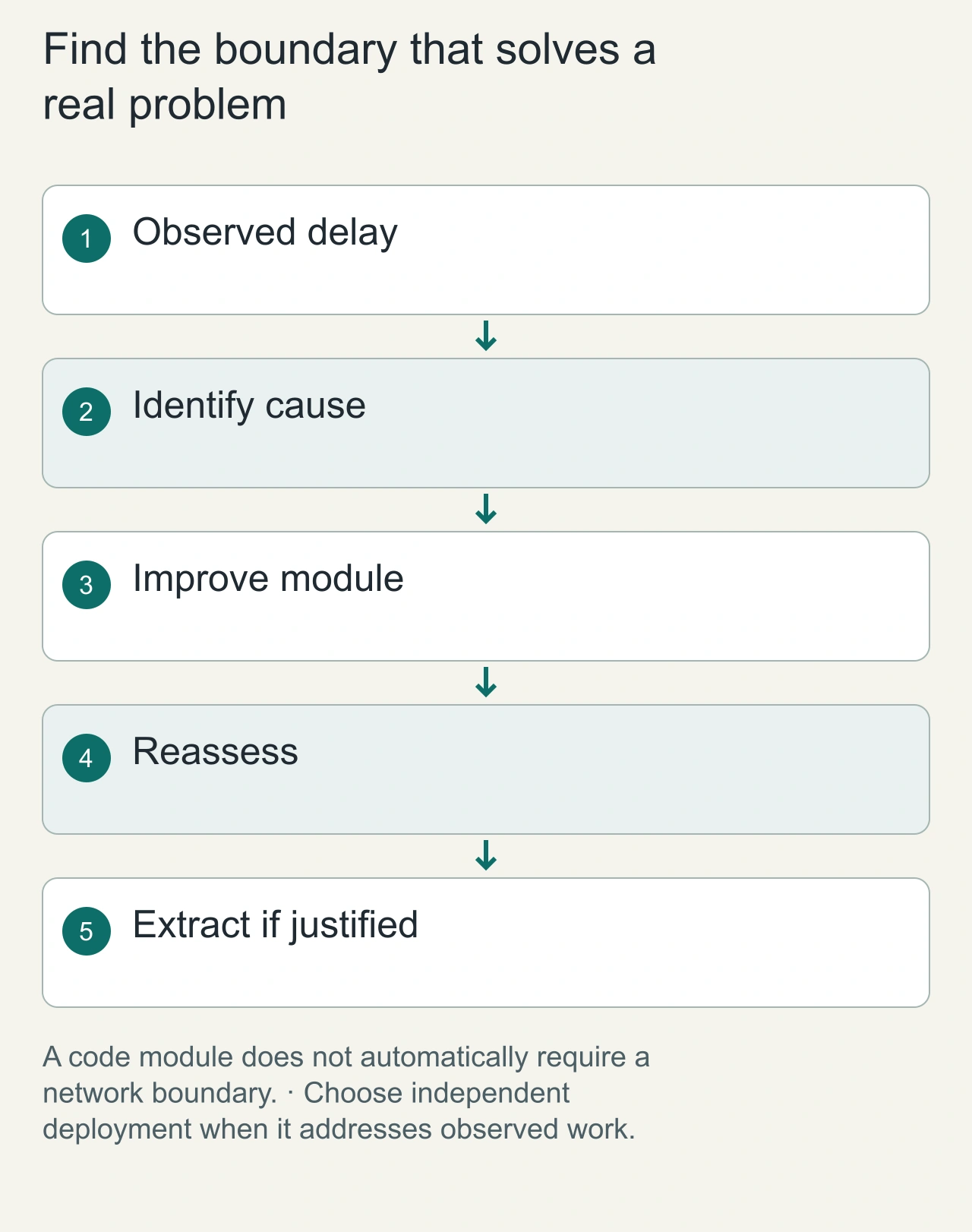
Imagine a small commerce team whose checkout, catalog, and order management live in one application. The first question is whether those modules need independent deployments, not whether they deserve separate boxes on a diagram. A modular monolith can give each domain a clear interface while preserving one release and one local debugging environment. If a catalog change rarely blocks checkout work, splitting both services immediately may create more coordination than it removes. Measure the actual source of delay before choosing a new boundary.
A useful worked example is a checkout change that repeatedly waits on a long catalog release. First inspect why: shared code, a fragile test suite, organizational ownership, or a genuinely different scaling need. Several of those problems can be improved inside one deployment. When the remaining problem is independent release or resource ownership, extracting a service becomes easier to justify. Microsoft's architecture guidance describes both the benefits and operational complexity of microservices; the tradeoff is ongoing operation, not a one-time code movement.
What a monolith actually looks like
A monolith packages the application's main capabilities into one deployable unit. That does not mean the code must be a pile of tightly coupled files. A well-designed modular monolith can still have strict module boundaries, domain-oriented packages, interfaces and independent test suites. The important boundary is deployment: a change to one module normally ships with the same application artifact as the others. Chris Richardson's pattern catalog describes the monolith as a single executable/deployable component and highlights advantages such as local interactions and easier ACID transactions, while also noting that maintainability and team autonomy become harder as the application grows. Microservices.io — Monolithic Architecture
What changes with microservices
Microservices move business capabilities behind independent runtime and deployment boundaries. AWS describes microservices as independent components organized around business capabilities that can be deployed and scaled independently. That independence is the main value — and the main source of extra complexity. AWS — What is Microservices Architecture? Microsoft's architecture guidance calls out the trade-offs explicitly: service discovery, data consistency, transaction management, network latency, testing, governance, versioning and observability all become harder in a distributed system. Azure Architecture Center — Microservices
The real question: where should the deployment boundary be?
The decision is not "old architecture vs modern architecture." It is:
Which capabilities need to change, scale, fail, or be owned independently? Imagine an e-commerce product. Search traffic may be far higher than checkout traffic. Image processing may need CPU-intensive workers. Payments may require stricter access controls. Those are possible reasons to create separate runtime boundaries. But if Catalog and Pricing always change together, share the same data and require synchronous calls for every request, splitting them too early can create a distributed monolith: many services that still have to deploy together.
Why a modular monolith is often the best starting point
A modular monolith keeps the operational simplicity of one deployable system while forcing code boundaries around business capabilities. Useful rules:
- Organize by business capability, not only technical layer.
- Do not let modules reach directly into each other's private internals.
- Define clear interfaces between modules.
- Keep ownership visible even if deployment is shared.
- Add contract tests around boundaries that may later become services.
- Use asynchronous events only where they solve a real coupling or workload problem. Martin Fowler's "Monolith First" argument came from observing that many successful microservice systems evolved from a monolith after the domain was better understood, while premature decomposition often created trouble. It is not a universal law, but the underlying reasoning remains useful: service boundaries become expensive once network and data contracts form. Martin Fowler — Monolith First
When a monolith is the better choice
Choose a monolith or modular monolith when several of these are true:
- The team is small. A handful of engineers rarely need dozens of independently deployable services.
- The domain is still changing quickly. Early product work often moves boundaries every week.
- You need fast iteration more than independent scaling.
- Most operations are transactional. One database transaction can be much simpler than coordinating distributed state.
- The traffic profile is similar across features.
- The team does not yet have mature observability and platform automation.
- You want the simplest architecture that can survive the next stage of growth. A monolith can still scale horizontally behind a load balancer. "Monolith" does not mean "one server."
When microservices start to earn their cost
Different parts scale very differently
If search needs many more instances than account settings, splitting the hot workload may reduce waste and simplify capacity planning.
Multiple teams need independent release cycles
A service boundary can reduce coordination when one team can build, test, deploy and roll back its capability without waiting for another team.
Failure isolation matters
A non-critical recommendation service should be able to fail without taking checkout down. Achieving that requires timeouts, retries, circuit breakers, queues and graceful degradation — not merely separate repositories.
Security boundaries are materially different
A payment or identity component may justify separate credentials, network policies, audit controls and a stricter deployment process.
Technology or runtime requirements diverge
A video-processing worker, search engine, real-time gateway and transactional API may have very different resource profiles.
The organization can operate distributed systems
Before going deep on microservices, you should already be comfortable with automated deployment, monitoring, logs, distributed tracing, secrets management, service ownership and incident response.
Account for the work that moves into the network
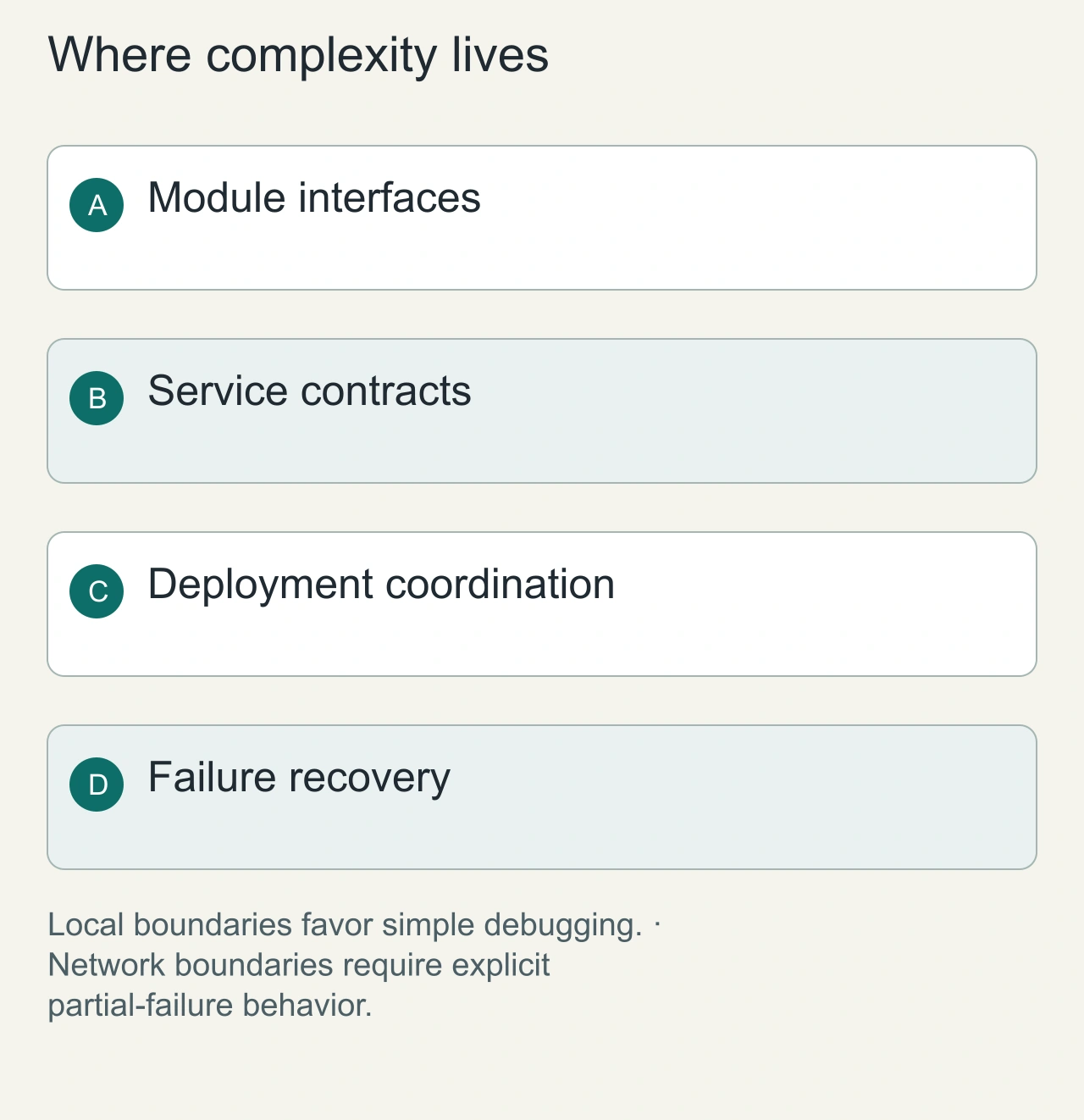
Within a process, a function call either returns or raises an error. Across a service boundary, the caller may time out while the other service has already completed the work. In our commerce example, an order write followed by a payment call needs a clear recovery path. Decide which service owns the authoritative state and how duplicated or delayed messages are handled. Splitting code without specifying those contracts turns a local refactor into an accidental distributed transaction design.
Compare the approaches using concrete operational jobs: deploying a fix, reproducing a failure, changing a schema, and responding to an outage. One application may need careful modularity to keep ownership clear. Several services need tracing, version compatibility, failure handling, and an on-call model. Neither approach guarantees good engineering. A team that cannot operate the added components should not assume a cleaner-looking architecture will remove that burden. The diagrams here use illustrative catalog, checkout, and order modules; they are not an observation of a particular production system.
The microservices tax most diagrams hide
A microservice diagram often looks beautifully separated. Production traffic does not. Now consider what happens when Payment times out after Inventory has already reserved stock. You need a policy for retries, idempotency and compensation. A local transaction became a distributed workflow. This is why patterns such as Saga, Transactional Outbox, idempotency keys, dead-letter queues and eventual consistency show up repeatedly in microservice systems. Those topics form a natural follow-up series for the AiFolder architecture cluster.
Decision flow: what should you choose?
The key is to make decomposition evidence-driven.
A practical migration path: the Strangler pattern
You do not need to rewrite an entire monolith at once. Route selected capabilities to new services while the rest stays in the existing application. A sensible extraction sequence:
- Pick a capability with a clear boundary and measurable pain.
- Put an interface around the existing module.
- Add observability before changing architecture.
- Move the workload behind the interface.
- Separate data ownership carefully.
- Route traffic gradually.
- Remove the old path only after correctness and operational behavior are proven.
Avoid the distributed monolith
A system has many services but behaves like a monolith when:
- one feature requires coordinated changes across several repositories;
- services share the same database tables;
- deployments must happen in lockstep;
- synchronous call chains are long and fragile;
- teams cannot test their service without running half the platform;
- an "independent" service cannot be rolled back independently. The number of services is not the measure of architecture quality. Independence is.
Common myths
"Microservices scale, monoliths do not"
Both can scale horizontally. Microservices are valuable when different capabilities need different scaling policies.
"Each microservice must be tiny"
A service should be small enough to understand and own, but large enough to contain a coherent business capability. Microsoft's guidance warns against overly chatty boundaries and recommends keeping capabilities together when consistency or communication would otherwise become problematic. Identify microservice boundaries
"Microservices automatically improve reliability"
Separate processes can isolate failures, but they also add network failures, retries, duplicated messages, stale data and dependency outages. Reliability comes from engineering the failure modes.
"A monolith means bad code"
A badly structured monolith is bad. A modular monolith with clear domain boundaries can be an excellent architecture.
Architecture checklist before choosing microservices
- We can name the business capability each service owns.
- Each proposed service can deploy independently.
- Its data ownership is clear.
- Cross-service calls are not excessively chatty.
- We know what happens when a dependency is slow or unavailable.
- Requests have correlation IDs and distributed traces.
- Operations are idempotent where retries can occur.
- We have a strategy for cross-service transactions.
- CI/CD can test and deploy each service safely.
- Every service has an owning team and on-call responsibility.
- The benefit is measurable: scaling, autonomy, isolation, security or runtime specialization. If several boxes are unchecked, the problem may not be the monolith yet.
What should a startup choose?
For a new startup or small product team, start with a modular monolith unless you already have a specific reason not to. Extract services incrementally when real data shows pressure. Search, media processing, AI inference, background jobs and high-volume ingestion are common early candidates because their resource and failure characteristics often differ from a transactional web application. This preserves speed while keeping a path toward service decomposition.
For interviews and system design practice
"Monolith vs microservices" is rarely a binary interview question. Strong answers explain trade-offs and triggers. A useful answer structure:
- State the constraints: traffic, team size, domain maturity and reliability targets.
- Start with the simplest architecture that satisfies them.
- Identify which component may need an independent boundary later.
- Explain the cost of that boundary: network, data consistency, deployment and observability.
- Describe a migration strategy instead of assuming a rewrite. Practice more architecture decisions in the AiFolder Interview Practice Hub. For a real production example of a gateway coordinating many internal capabilities, see How Uber Built an MCP Gateway for Thousands of Internal APIs.
Practical takeaway
A monolith optimizes for simplicity and local coordination. Microservices optimize for independent change and ownership. The wrong question is "Which architecture is best?" The better question is:
Which boundaries need to be independent enough to justify the cost of a distributed system? If the answer is not clear yet, a modular monolith gives you time to learn the domain without paying the full microservices tax.
Extract one service with a return path
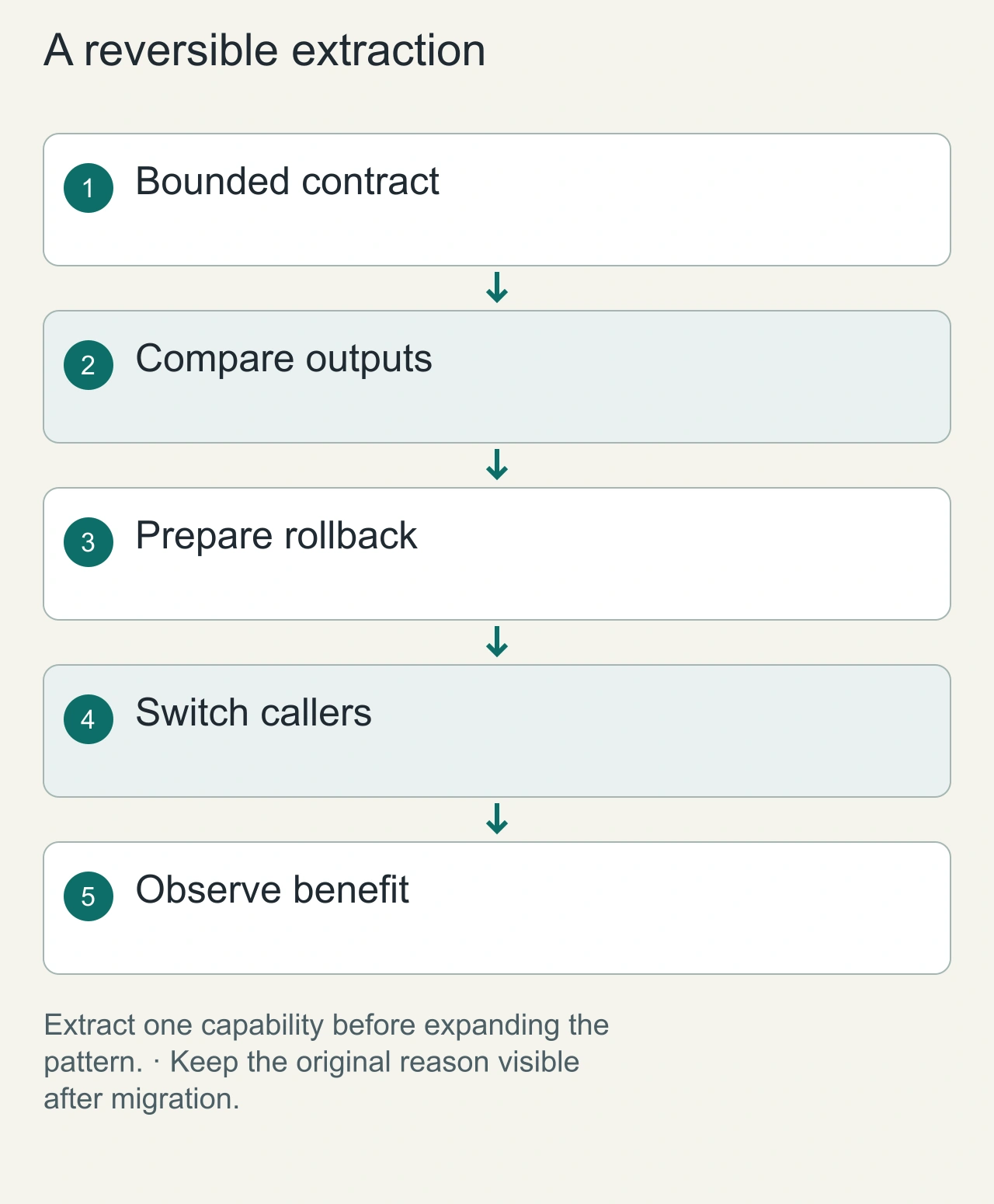
Choose a bounded capability with a clear owner and limited interactions. A catalog search service is often easier to reason about than a payment-and-order workflow, because its first version can expose a read contract. Define an interface, compare old and new outputs on representative requests, and establish rollback before switching callers. Keep unrelated code changes out of the extraction so that a reviewer can tell whether a failure comes from the new boundary or a changed business rule.
After the switch, observe the reason you extracted the service: deployment lead time, scaling pressure, or failure isolation. Also observe the new costs, such as extra incident coordination and compatibility work. If the hoped-for benefit does not appear, the architecture should remain open to correction. A successful extraction is one that improves the intended constraint while leaving the product understandable and recoverable. It is not simply a repository that now contains more applications. Preserve a short decision record so that the next engineer sees the evidence behind the boundary. Review the decision again after the team or workload changes.
Sources and further reading
- Thi Nguyen's software architecture notes — used as an idea seed; this article is independently rewritten and expanded.
- AWS — What is Microservices Architecture?
- Azure Architecture Center — Microservices architecture style
- Azure Architecture Center — Identify microservice boundaries
- Microservices.io — Monolithic Architecture
- Martin Fowler — Monolith First