Quick verdict
This is a buyer's guide based on official specifications, not a hands-on review. Real-world performance, battery and sustained heat measurements remain pending.
NVIDIA RTX Spark is a new Windows-focused local-AI hardware platform, not the same product as DGX Spark. NVIDIA lists up to 128 GB unified memory, up to 6,144 Blackwell RTX GPU cores, a 20-core Grace CPU and up to one petaflop of FP4 AI compute. These are vendor maximum specifications, not AiFolder measurements.
Who should consider it?
Developers wanting CUDA tooling on a Windows laptop, creators needing RTX acceleration, and teams running local agents without metered cloud inference. Model compatibility depends on weight format, quantization and memory overhead. Maximum memory is not the same as free model memory.
What's new and when can you buy it?
NVIDIA announced RTX Spark on October 7, 2026, with Windows laptop preorders open that day, laptop availability announced for October 16, and compact desktops planned for November. Partner designs include Microsoft, Lenovo, HP, Dell, ASUS and others. Availability and pricing depend on region and specific SKU. NVIDIA announcement.
Vendor specifications versus buyer reality
| Published maximum | NVIDIA claim | What to verify |
| Unified memory | Up to 128 GB | Actual SKU, usable memory, bandwidth |
| GPU | Up to 6,144 Blackwell RTX cores | Thermals and sustained clock |
| CPU | Up to 20-core Grace | CPU-heavy preprocessing speed |
| AI compute | Up to 1 PFLOP FP4 | Precision, sparsity and model support |
These figures describe platform ceilings, not results AiFolder measured. Official specifications.
Does a 120B model really fit?
Weight-only arithmetic gives a rough lower bound: 120 billion parameters at 4 bits each require 60 billion bytes (about 55.9 GiB) before quantization metadata, runtime allocations, KV cache, activations and OS memory. This is a calculation, not an inference benchmark. Model architecture, expert routing and actual quantization format can change the picture. NVIDIA advertises up to 120B models with long context; verify the exact checkpoint and context size on a retail machine before buying. RTX Spark product page.
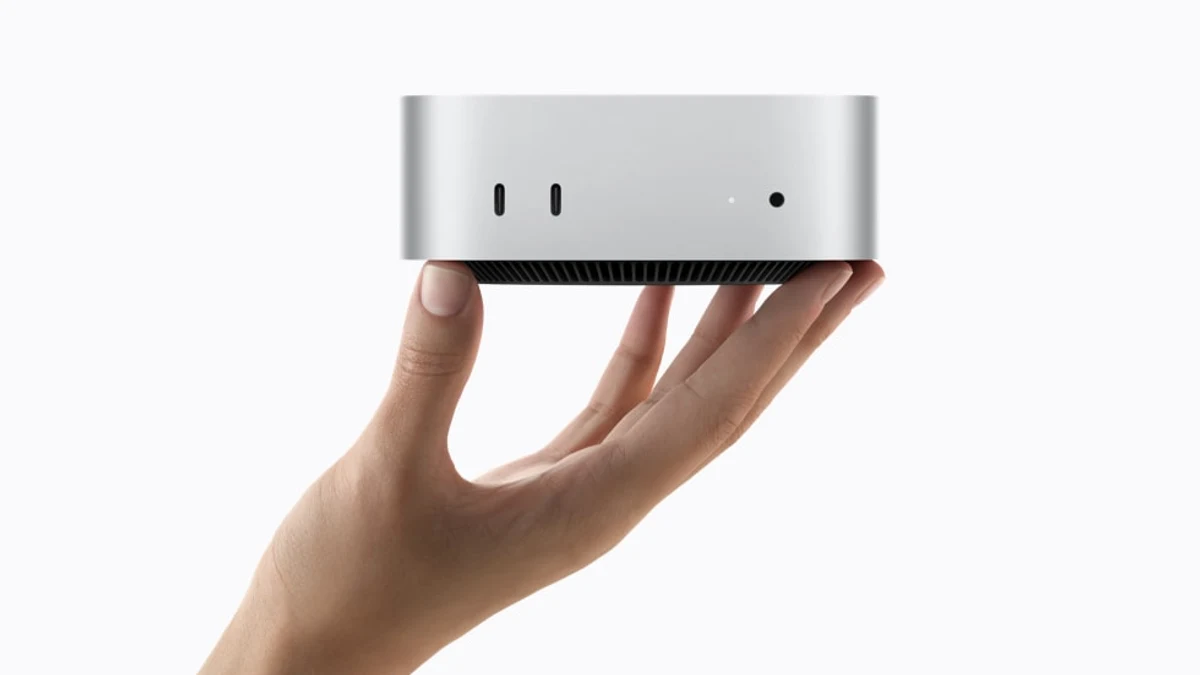
RTX Spark vs Mac mini: choose the workflow
| Decision | RTX Spark Windows PC | Mac mini |
| CUDA / TensorRT workflow | Native NVIDIA ecosystem | Not CUDA-native |
| Apple app development | Requires another Mac | Native macOS/Xcode |
| Hardware form | Laptop or compact desktop | Compact desktop |
| RAM and speed | Depends on RTX Spark SKU | Depends on Mac mini generation and SKU |
| Valid benchmark | Same model, quantization, context and power mode | Same controlled setup |
Avoid comparing NVIDIA's FP4 peak number with an Apple GPU figure as though they measured the same workload.
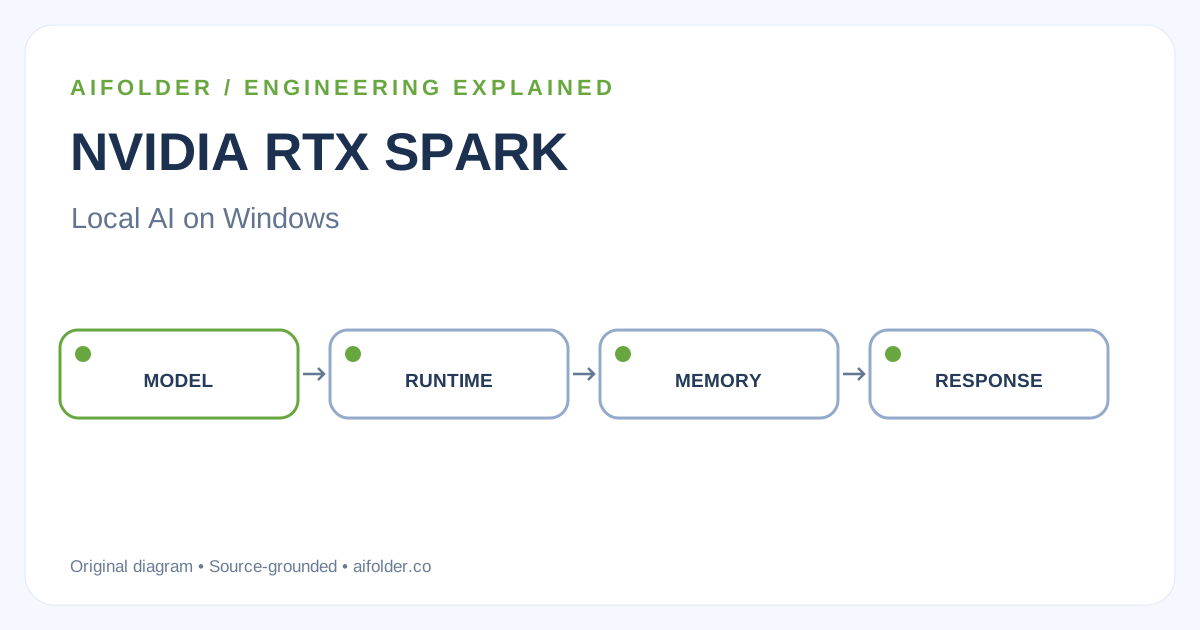
Model request flow
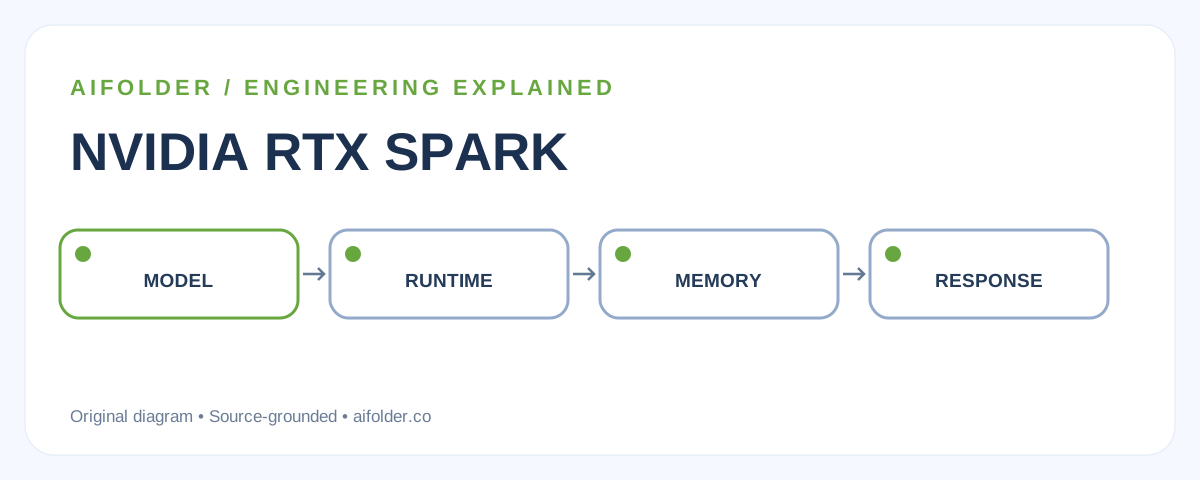
Original AiFolder conceptual diagram.
Buying checklist
Check the exact OEM SKU, RAM, SSD, display, charging, cooling, warranty and local price. Demand sustained tokens per second, first-token latency, memory consumption and battery drain using the model you will actually run. Compare with a Mac only under matched prompts, context and quantization. A local agent still needs access controls and secrets management.
Original AiFolder test plan — pending
Run the same 8B, 32B and larger quantized checkpoints on both systems. Record model file hashes, backend versions, prompt lengths, tokens per second, p95 first-token latency, power, heat and noise. No retail RTX Spark unit has been tested by AiFolder.
FAQ
Is RTX Spark the same as DGX Spark? No. RTX Spark is NVIDIA's Windows PC platform; DGX Spark is a separate product line.
Will every model fit into 128 GB? No. KV cache, runtime overhead and model architecture determine fit.
Should I preorder? Only when the specific OEM SKU, warranty, regional price and workload compatibility meet your needs. Otherwise wait for independent sustained tests.
Related AiFolder reading
Source of truth and limitations
Primary sources:
- blogs.nvidia.com/blog/local-ai-rtx-spark-microsoft-windows-event/
- www.nvidia.com/en-us/products/rtx-spark/
Disclosure: The vendor or standards documents above support product capabilities and protocol claims. AiFolder has not run hands-on performance, security, or device benchmarks for this article; proposed experiments remain unexecuted.