
Cloudflare reworked Containers around AI-agent sandboxes on September 30, 2026. The update adds runtime selection of images and instance types, faster startup and filesystem snapshots in public beta.
Why agent sandboxes are different
Traditional containers assume an application is deployed and updated as a unit. An agent workspace is created after a task arrives. A coding agent may need to clone one repository, install a specific toolchain, execute generated commands, run tests, sleep while waiting for review, resume later with files intact and disappear when the task is complete. With the new durable-object scheduling policy, application code can select a declared image and instance size at runtime. Cloudflare also added filesystem snapshots so a workspace can be saved and restored.
A sandbox has a lifecycle, not just an image
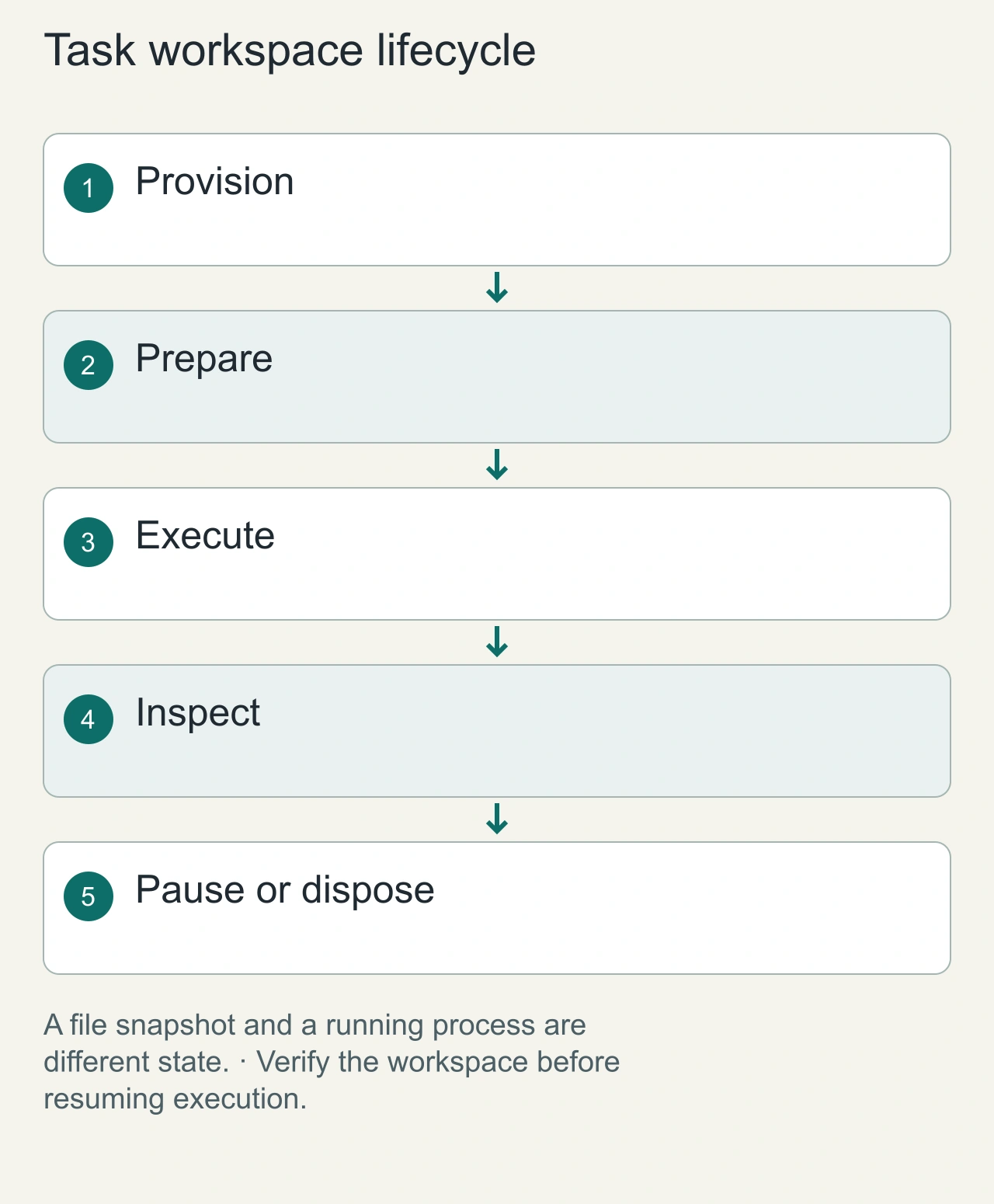
Imagine a coding assistant that starts a workspace for each customer task. It clones a repository, installs dependencies, runs a preview, and waits for a person to inspect the result. At that point, the important object is the task workspace: which files it contains, whether a command is still running, and how it resumes after a pause. Cloudflare's sandbox documentation describes task-oriented execution on its infrastructure. The operational decision is whether that lifecycle fits your application, rather than whether you can start a generic container.
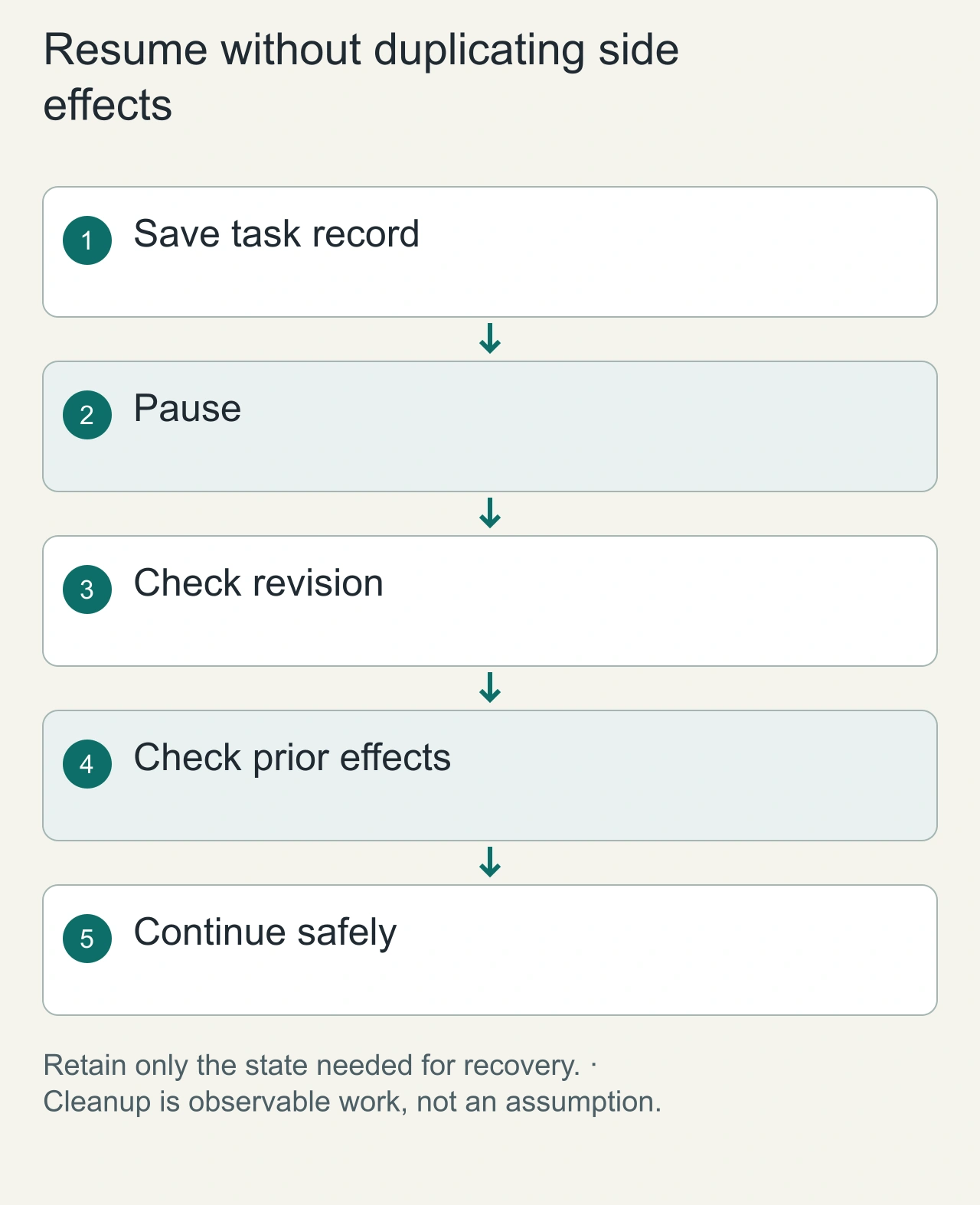
Separate the phases in your design: provision, prepare, execute, inspect, pause, resume, and dispose. Record the task identifier at every phase. A snapshot of files can help preserve a workspace, but it should not be confused with a live process or an external database checkpoint. After resuming, verify the repository revision, generated artifacts, and required environment before continuing the command sequence. This prevents an agent from assuming that a restored directory also restored every connection, token, or in-memory state it used earlier.
Vendor benchmark
Cloudflare cites an independent ComputeSDK benchmark where median startup fell from just over four seconds to 648 ms, describing the change as more than 6x faster. AiFolder has not independently reproduced this result.
Choose isolation and persistence deliberately
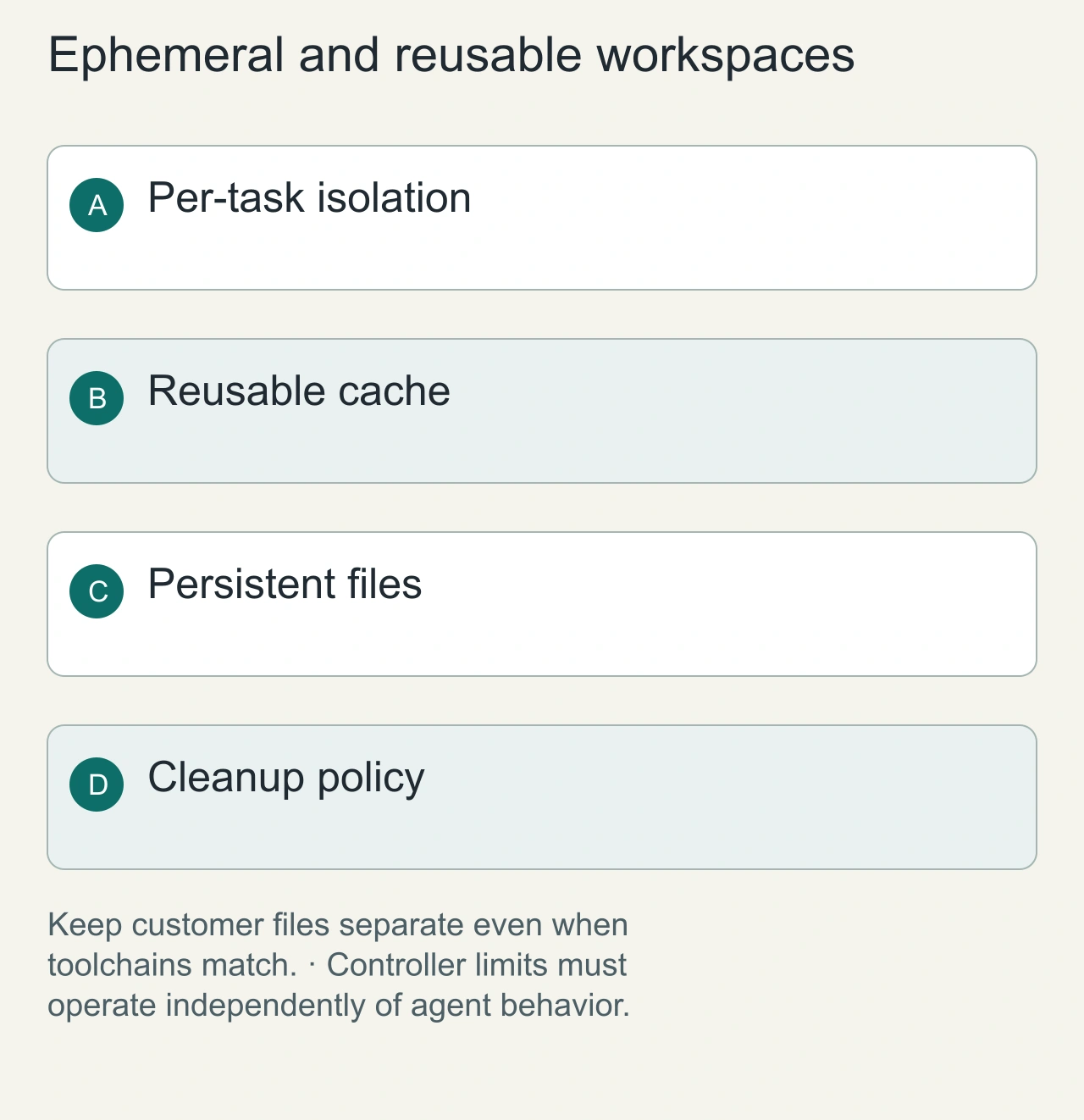
One sandbox per task makes ownership clearer: the task's files and processes belong to one unit that can be disposed of together. Reusing a sandbox may avoid repeated setup, but it also carries stale files, caches, and credentials forward. In a hypothetical code-review service, separate customers should not share a writable workspace simply because the repositories use the same language. Keep reusable dependency artifacts separate from user material, and decide explicitly which caches may cross the boundary.
The controller that owns the sandbox should enforce time, resource, and network limits. Those limits should not depend on the model remembering to stop. A runaway install process and a legitimate long build can look similar from a distance, so report stage-specific progress and capture the relevant command exit status. Compare an ephemeral task with a persistent workspace using the same acceptance conditions: setup cost, recovery behavior, data isolation, and cleanup. We have not measured Cloudflare startup latency against another provider; the diagrams describe a design, not a benchmark.
Security is more important than startup speed
Fast sandboxes are useful, but isolation is the more important property when a model can execute commands. Agent environments should start with minimum permissions. Production credentials should not be ambient, and consequential actions should be gated outside the model. Related AiFolder content: AI Agent Permissions Explained, AI Coding Benchmark, and the AiFolder AI Hub.
Why snapshots matter
Without persistence, resumed tasks repeatedly pay setup cost. Snapshots can preserve dependencies and generated files for code review, long builds and human approval. They also create lifecycle questions: retention, secrets inside snapshots, encryption and patching of stale environments.
Planned AiFolder test
A useful comparison will run the same Node.js coding task on Cloudflare Containers and a conventional container/VPS setup. We plan to measure cold-start time, time to usable shell, dependency-cache behavior, pause/resume, filesystem persistence, network-policy controls and cost for bursty versus long-running sessions. Benchmark status: pending.
Design for interrupted work and bounded cost
A human review may take longer than the command run. Instead of holding a workspace active without a reason, decide what state must survive and which process can stop. Save the diff, relevant logs, and preview artifacts before pausing. On resumption, use an explicit readiness check rather than retrying the last command blindly. If the previous attempt uploaded an artifact or wrote a record, record that side effect so that a resumed task does not duplicate it.
At disposal, verify that temporary credentials, network exposure, and retained files follow the owner's policy. A successful tool response is not proof that every external resource was removed. For a production rollout, begin with a small workload and observe completion, interruption, and cleanup separately. Keep a provider-independent task record so that your product can explain the state even when the sandbox service is unavailable. This makes the sandbox an execution component within your application rather than the only place where the task's history exists. Include interruption and cleanup cases in the first operational review, before treating an uninterrupted successful run as sufficient evidence.
Sources
Cloudflare Blog — “Cloudflare Containers, rebuilt to scale agent sandboxes,” September 30, 2026.
Practical takeaway
The important change is not simply faster containers. Cloudflare is moving environment configuration from deployment time to task time, which matches how agents consume computers. Runtime-selected environments, durable identity and resumable files are likely to become standard agent-infrastructure primitives.