Quick answer
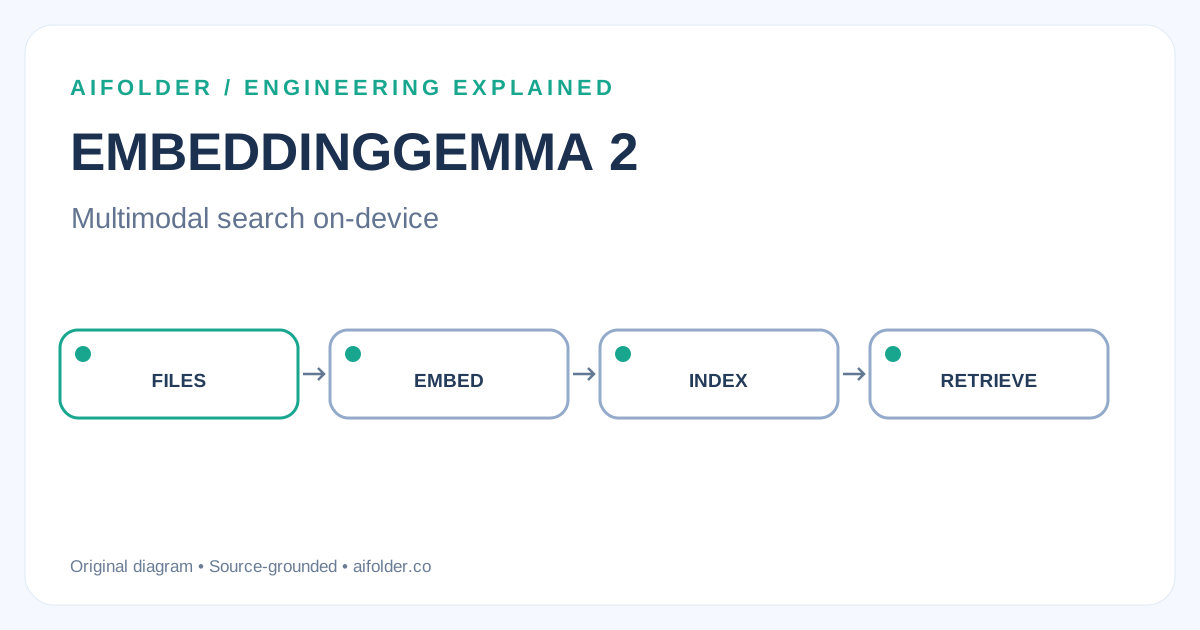
EmbeddingGemma 2 is Google's 740M-parameter multimodal embedding model for private retrieval across text, images, audio and video.
Why this model matters
Google reports 191 MB active RAM for text-only weights and 567 MB for the full multimodal model on a Pixel 11 Pro; these are vendor figures.
It maps text, code, images, audio and video frames into a shared vector space, enabling private search across a local media library. Google's official model announcement specifies 740 million parameters and modular text, vision and audio encoders. These are vendor specifications, not AiFolder benchmarks.
Retrieval architecture
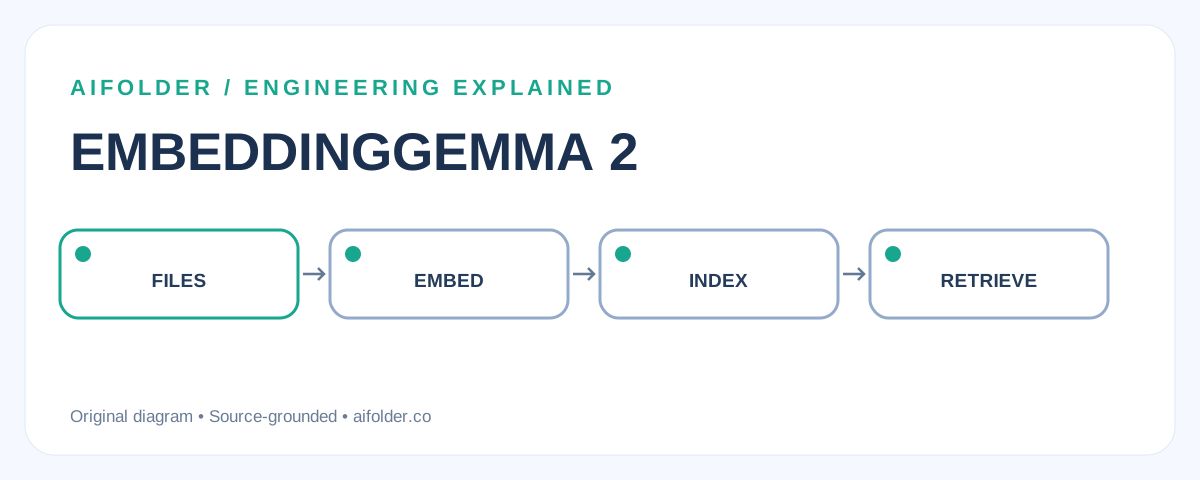
Google AI Edge Gallery demonstrates SQLite-backed local indexing. A video app still needs keyframe selection and timestamps; an embedding model is not a speech transcription engine.
Vector storage: 768 versus 128 dimensions
EmbeddingGemma 2 supports Matryoshka truncation from 768 to 512, 256 or 128 dimensions. For 100,000 float32 vectors, raw storage is approximately 307 MB at 768 dimensions versus 51 MB at 128. These are AiFolder-calculated byte counts, not measured index sizes. ANN structures and metadata add overhead. Truncation can reduce retrieval quality, so measure recall@k.
Local inference choices
Google describes MediaPipe UniversalEmbedder and SemanticRetriever for integrated retrieval, and LiteRT for lower-level runtime control. ML Kit integration was described as upcoming, not generally available at the announcement. Vendor-reported image latency and memory must not be presented as AiFolder measurements.
Practical ranking example
After the embedding runtime returns vectors, similarity ranking is independent of the model-loading API:
function dot(a: number[], b: number[]): number {
  if (a.length !== b.length) throw new Error("dimension mismatch");
  return a.reduce((sum, value, i) => sum + value * b[i], 0);
}
console.log(dot([1, 0], [0.8, 0.6])); // 0.8
This dot-product example assumes normalized embeddings. The example vectors are synthetic and do not measure model quality.
Failure cases
- Store the model revision and embedding dimension with the index; re-index on incompatible changes.
- Preserve source filenames and timestamps so users can verify retrieved media.
- Protect local storage, backups and telemetry; on-device inference alone is not a complete privacy guarantee.
- Measure sustained battery drain and heat on target hardware.
AiFolder original test plan — pending
Index 1,000 consented images and 50 clips on the same device. Compare 768/256/128 dimensions on recall@5, indexing time, query latency, memory peak and battery drain, including airplane mode. No device tests have been run.
Encoder configurations
| Model loading | Parameters | Best first use |
| Text/code | 270M | Local code search |
| Text + vision | 440M | Photo and document search |
| Text + audio | 570M | Voice memo retrieval |
| All modalities | 740M | Mixed media library |
These configurations and their compatible shared vector space are documented by Google's October 2026 developer guide. Parameters are vendor specifications, not AiFolder tests.
Correct query/document prompts
The official Python integration uses SentenceTransformer("google/embeddinggemma-2"). Encode queries with prompt_name="SearchQuery" and documents with prompt_name="Document". Use identical truncate_dim for both sides, and normalize before cosine or dot-product ranking.
Retrieval prompts and code considerations
Google's official Python example uses sentence-transformers 6.1 or later. Query embeddings use SearchQuery; indexed documents use Document. Normalize both, keep the same truncation dimension, and store the model revision with the index. The example is documented in Google's developer guide. AiFolder has not executed the model or measured latency.
Production checklist
Keep a model revision, vector dimension, normalization rule and media source ID with every index. Batch media indexing, remove vectors for deleted content, and test airplane mode if you claim offline behavior. Quantized model memory and raw vector storage are different quantities. Vendor latency figures cannot predict sustained mobile battery performance.
FAQ
Does this replace speech-to-text? No; semantic audio retrieval and verbatim transcription solve different tasks.
Can 128 dimensions work for photos? It may, but Google reports a larger quality drop for multimodal search than for text; test recall before shipping.
Is all processing automatically private? Only if the surrounding app also handles analytics, storage and network access appropriately.
Related AiFolder reading
Source of truth and limitations
Primary sources:
- developers.googleblog.com/en/embeddinggemma-2-the-developer-guide/
- blog.google/innovation-and-ai/technology/developers-tools/embeddinggemma-2/
Disclosure: The vendor or standards documents above support product capabilities and protocol claims. AiFolder has not run hands-on performance, security, or device benchmarks for this article; proposed experiments remain unexecuted.