

Original AiFolder editorial illustration. Not an independent model benchmark. Updated October 8, 2026 · Research-based comparison · No AiFolder API benchmark has been run for this article. Anthropic released Claude Haiku 5.5 on October 7, 2026, positioning it as a smaller, faster model for high-volume tasks and cost-sensitive AI applications. The useful question for developers is not simply whether Haiku has a lower token price. It is whether your agent can finish the intended job reliably enough that fewer expensive model calls outweigh additional retries. Anthropic's release notes provide pricing and vendor-run evaluations; they do not replace testing on your own workload.
Quick answer: use Haiku for narrow, repeatable work
Haiku 5.5 is an attractive starting point for classification, extraction, search-result summaries, content compaction, quick bug triage, and focused subagent tasks. Sonnet 5.5 is more appropriate when the task requires multi-file reasoning, complex terminal work, or sustained debugging. This is consistent with Anthropic's own positioning, rather than an independent AiFolder conclusion. A practical architecture is a two-tier agent: start on Haiku for the low-risk, clearly scoped step; escalate to Sonnet when the result fails validation, tool retries accumulate, or the user requests higher-stakes analysis. Escalation needs deterministic guardrails—not a model declaring itself correct.
Break the agent job into different kinds of work
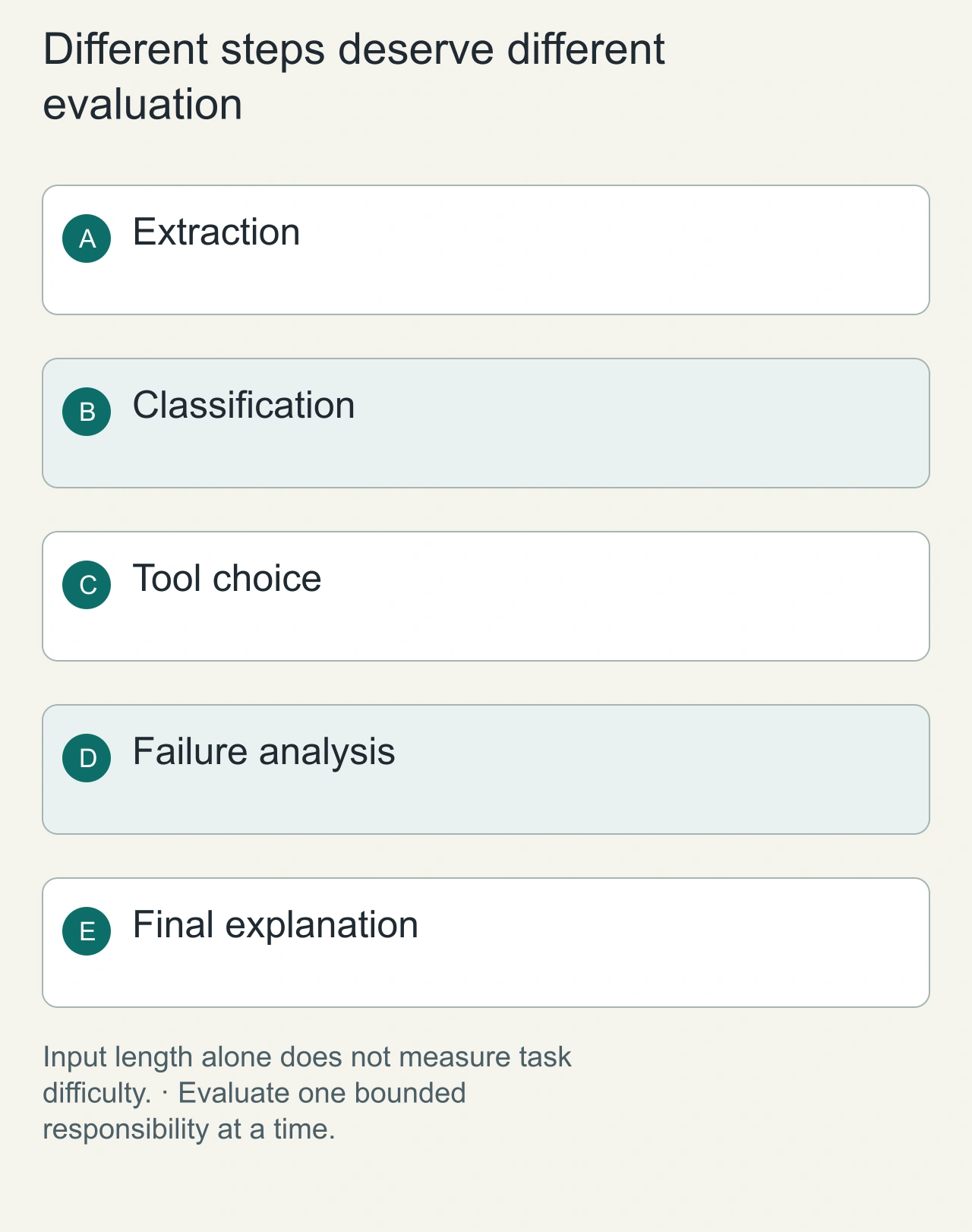
A long agent task is rarely one uniform reasoning problem. It may classify a request, extract fields, choose a tool, inspect a failure, and write a final explanation. A smaller model can be worth evaluating for a bounded step even when the complete workflow benefits from a larger model. Start by naming those steps and their acceptance conditions. In a hypothetical support agent, extracting an order number is a different job from deciding how to handle an unusual account dispute.
Anthropic's current release positions Haiku 5.5 as a smaller model, and the model documentation establishes the available identifiers and capabilities. That vendor positioning does not prove the right choice for your application. Assign a candidate model to a specific step and observe whether it finishes the required operation without extra retries or manual repair. Keep a larger-model fallback for situations defined by your validation, rather than assuming that every short input is easy or that every long input requires the largest model.
What changed with Claude Haiku 5.5?
The October release adds adjustable effort to the Haiku family and makes the model available through Anthropic's platform and partner clouds. Anthropic identifies the API model as claude-haiku-5-5. It also reduced the cache-read price for Sonnet 5.5 as part of the announcement. These details matter when comparing an orchestrated agent system with repeated context reuse rather than single isolated prompts.
Anthropic reports approximately 75% lower average cost compared with Haiku 4.5, with workloads and caching affecting the actual result. Treat that as the publisher's estimate, not a universal discount on every application.
Count retries and review in the cost of success
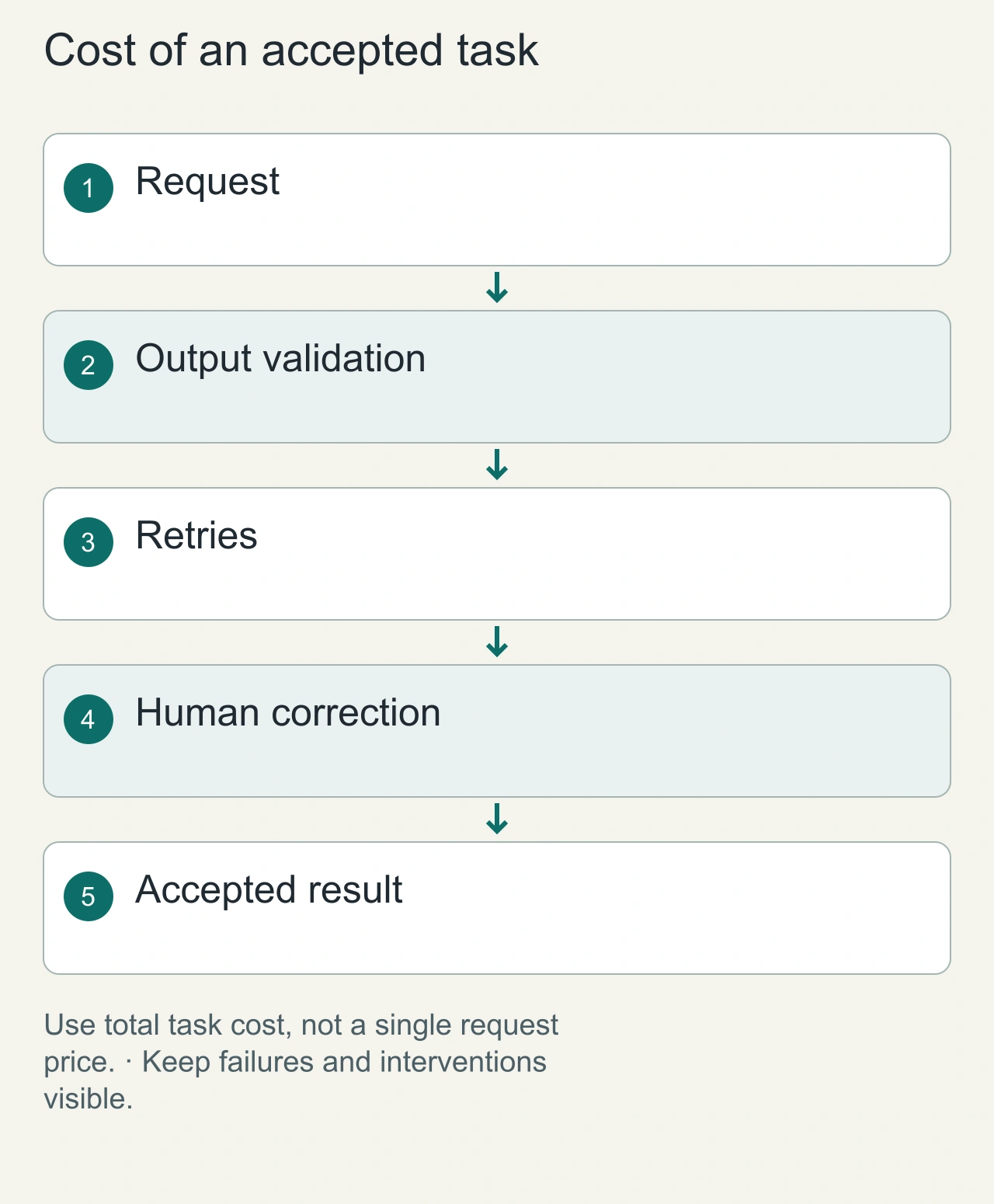
A lower request price can disappear when the workflow repeats an unsuccessful step. Compare cost per accepted task with the same tools, prompt, data, and stopping rule. Record invalid output, wrong tool arguments, unnecessary calls, and human corrections. In the order-number example, a missing identifier should become an explicit request for clarification rather than an invented number. A workflow that looks cheap because it hides failed cases is not a useful comparison.
Build a small evaluation set with ordinary cases and deliberately difficult ones: missing fields, contradictory context, distracting quoted text, and a tool that returns an error. Keep expected results outside the agent's input. If you tune the prompt on those examples, reserve unseen cases for the final comparison. We have not run an AiFolder Haiku-versus-Sonnet API benchmark for this article. The evaluation diagram is a proposed method, and the factual title should describe model selection instead of implying measured performance that is not available.
Pricing: small prompts versus large prompts
The following figures are Anthropic's published rates per one million tokens as of October 8, 2026:
- Haiku 5.5, prompts up to 100,000 tokens: $0.10 input; $0.50 output; $0.01 cache reads.
- Haiku 5.5, prompts over 100,000 tokens: $0.50 input; $2.50 output; $0.05 cache reads.
- Sonnet 5.5: $2.00 input; $10.00 output; $0.10 cache reads.
- Haiku 4.5: $1.00 input; $5.00 output; $0.10 cache reads. These are nominal API rates, not subscription prices or the full cost of hosted agent execution. Check provider billing and current prices before making budget decisions.
Example: why per-token cost is not enough
Consider a hypothetical task that consumes 10,000 input and 1,000 output tokens with no caching or retries. Using the published rates for eligible short prompts:
- Haiku 5.5 token bill: $0.0015.
- Sonnet 5.5 token bill: $0.0300. That arithmetic shows a roughly 20× price difference for this particular token mix, not a 20× reduction in agent operating cost. One successful Sonnet call can still be cheaper than many failed Haiku attempts, especially when retries repeat a large prompt or tool actions carry additional costs. A more useful metric is:
cost_per_successful_task =
  total_model_and_tool_cost_across_all_attempts
  / number_of_verified_successes
Track the numerator at request level. Count model tokens, cached tokens, retries, tool calls, and any hosting charges. Define success with automated tests or independently checkable answers.
What do the published coding benchmarks say?
In Anthropic's October 7 release table, Haiku 5.5 reports 39.2% on Terminal-Bench 4.0 while Sonnet 5.5 reports 70.6%. These are vendor-reported results under Anthropic's evaluation settings. They suggest that the larger model remains better suited to difficult terminal workflows, but they are not AiFolder results, not a guarantee for your repository, and not necessarily directly comparable with scores reported by other vendors. Different agent scaffolds, tool permissions, context sizes, and effort levels can alter results. Do not mix benchmark numbers from unrelated runs into a single definitive leaderboard.
A reproducible AiFolder benchmark to run
For a developer-focused assessment, define a fixed suite with at least four task categories:
- Structured extraction: convert 20 messy product descriptions into validated JSON, with a schema and exact-match checks.
- Repository debugging: solve small, isolated TypeScript defects with locked dependency versions and hidden tests.
- Agent tool use: query a mocked API and produce a correctly sourced answer, with a cap on invalid tool calls.
- Longer coding tasks: modify several files in a fixture repository, run tests, and inspect the patch for unintended changes. Run each task multiple times per model, using the same prompt, tool access, temperature, timeout and acceptance criteria where possible. Save the raw response, token accounting, total wall time, failure reason, and git diff. Calculate median latency, verified pass rate, and cost per success. Separate API price from measured compute time. AiFolder has not yet executed this suite for Haiku 5.5.
Where Haiku 5.5 fits in an agent architecture
Good candidates: extracting fields from trusted documents, suggesting tags, summarizing tool outputs, retrieving one answer from a short corpus, and ranking a small set of already-generated choices. Escalation candidates: security-sensitive code changes, ambiguous requirements, multi-step debugging, migrations across services, or situations where incorrect output could trigger a destructive action. Do not choose purely by model size: privacy, availability, data retention, regional constraints and tool-call governance are separate selection dimensions. For a real content platform, a typical workflow might be: extract candidates with Haiku → validate strict JSON → ask Sonnet to investigate only low-confidence cases → require human approval before publication. That reduces expensive calls without removing accountability.
Route with an explicit fallback contract
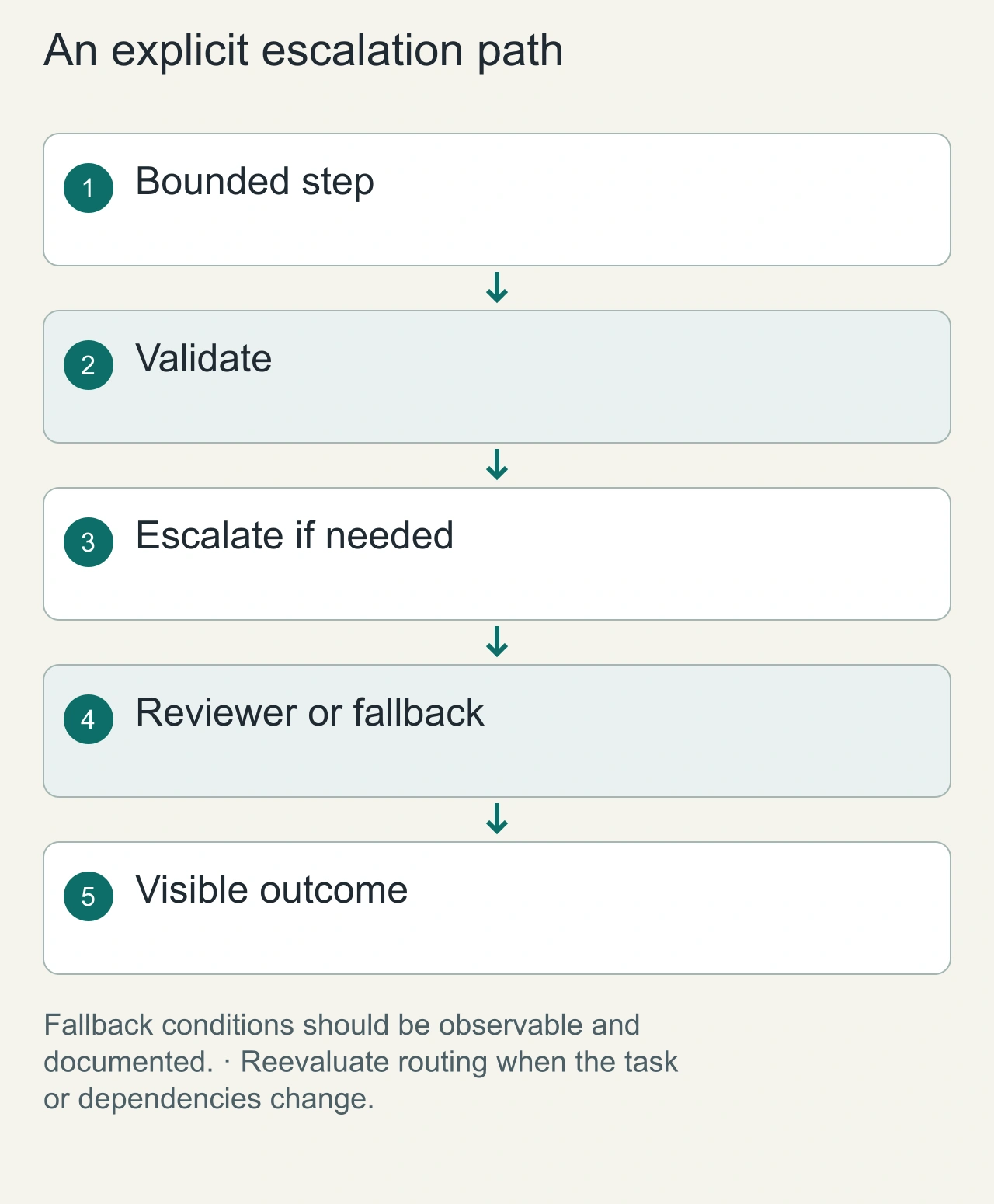
A production routing rule should say when to use the smaller model, when to escalate, and what happens if both attempts fail. For a support workflow, routine extraction may use one route while an ambiguous dispute moves to a reviewer. The escalation trigger can be missing required fields, failed schema validation, or a known high-impact task category. Avoid asking the model to certify its own correctness as the only gate; enforce observable checks in application code.
Roll out the route gradually and preserve a sample of outcomes for review under your data-retention policy. Track which cases escalate and why, because a rising fallback rate may signal a changed input distribution or a broken tool. Reevaluate after prompt, model, schema, or tool changes. A successful routing design reduces a clearly measured burden while maintaining the acceptance standard. It should leave a understandable failure path for the user rather than an endless sequence of increasingly expensive model calls. These are design requirements for a future measured evaluation, not evidence that either model already meets them in your application. Publish the acceptance rules alongside any future result so another team can interpret the comparison.
Frequently asked questions
Is Claude Haiku 5.5 cheaper than Sonnet 5.5?
Yes, according to Anthropic's published per-token API prices for the tiers listed above. That does not establish which model has the lower cost per successful task for your workload.
Can Haiku 5.5 replace Sonnet for coding?
It may be sufficient for focused edits and subagent tasks. Anthropic's own published terminal benchmark still favors Sonnet on complex agentic coding.
Does prompt caching change the comparison?
Yes. The share of cached input tokens, cache-write rates, long-context price thresholds, and number of turns can materially change total cost.
Has AiFolder tested both models?
Not for this article. All performance scores above are attributed to Anthropic and the cost example is arithmetic based on published pricing. An original benchmark will be labeled separately when completed.
Related AiFolder reading
Explore the AI Hub for model and agent categories, the AI Tools directory for alternatives, and the Interview Practice Hub for structured coding exercises.
Sources and methodology
- Anthropic — Claude Haiku 5.5 official release, October 7, 2026. Used for model availability, price tiers and vendor benchmarks.
- Anthropic — platform model documentation. Check model IDs and deployment features before integration.
- AiFolder source check: October 8, 2026. No live API test, independent benchmark, or claim of first-hand model usage is made here.