Quick answer
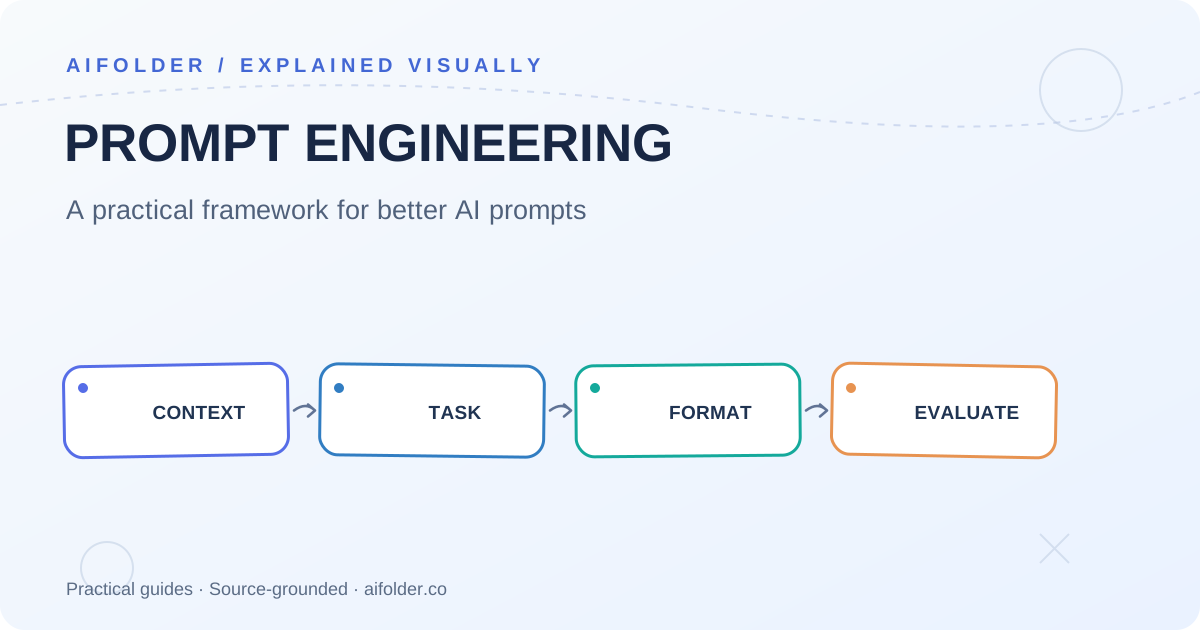
Prompt engineering is the practice of designing and improving instructions and context so that a generative AI model produces outputs that better meet a defined task. It is more than adding clever words: useful prompts describe the job, supply relevant information, set boundaries, and make the desired answer easy to evaluate.
An effective prompt is not a guarantee of correctness. Treat it as an interface contract that should be tested against real examples.
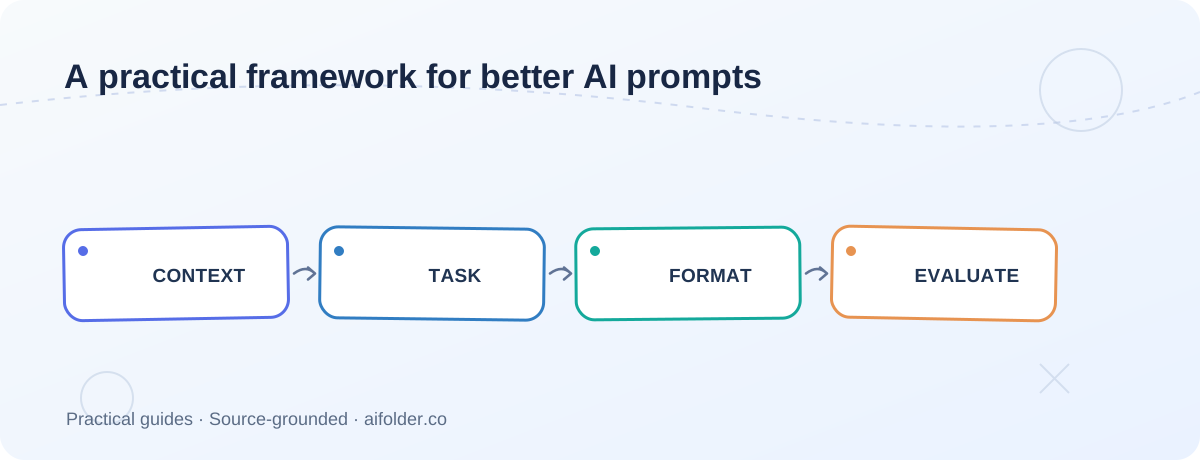
What makes a good AI prompt?
A practical prompt usually includes six building blocks:
- Context: What background does the model need?
- Task: What specific action should it take?
- Input: What text, data, or situation should it work with?
- Output format: What should the result look like?
- Examples: Can a few representative inputs and outputs demonstrate the pattern?
- Constraints: What should the model avoid or limit?
You do not need all six for every task. Simple questions often work with a direct instruction. Consistent applications benefit from explicitly defining format and constraints.
A weak prompt and a stronger alternative
Weak: Write a product description.
Stronger:
Task: Write a concise product description for an online store.
Product: A stainless-steel insulated water bottle.
Audience: Office workers and commuters.
Known facts: 750 mL capacity; reusable; leak-resistant lid.
Format: One 30-word introduction, then three short benefit bullets.
Constraints: Do not invent temperature-retention claims or certifications.
Tone: Clear and practical.
The stronger version provides boundaries and a testable structure. Notice that it explicitly tells the model not to fill information gaps with invented product claims.
Zero-shot or few-shot?
A zero-shot prompt gives an instruction without providing examples. For instance, ask the model to classify a review as positive, negative, or neutral.
A few-shot prompt supplies one or more labeled examples before the real input. This is helpful when your classification labels or output conventions are unusual.
Try zero-shot first. Add examples when you can describe genuine failure cases and show what the correct output should be. Do not assume more examples always mean better results: long prompts can increase latency and cost.
Prompt engineering for developers
In an application, a prompt should be maintained like other important product logic:
- Store prompt templates with version identifiers.
- Separate stable instructions from user-supplied content.
- Validate structured responses rather than trusting their shape.
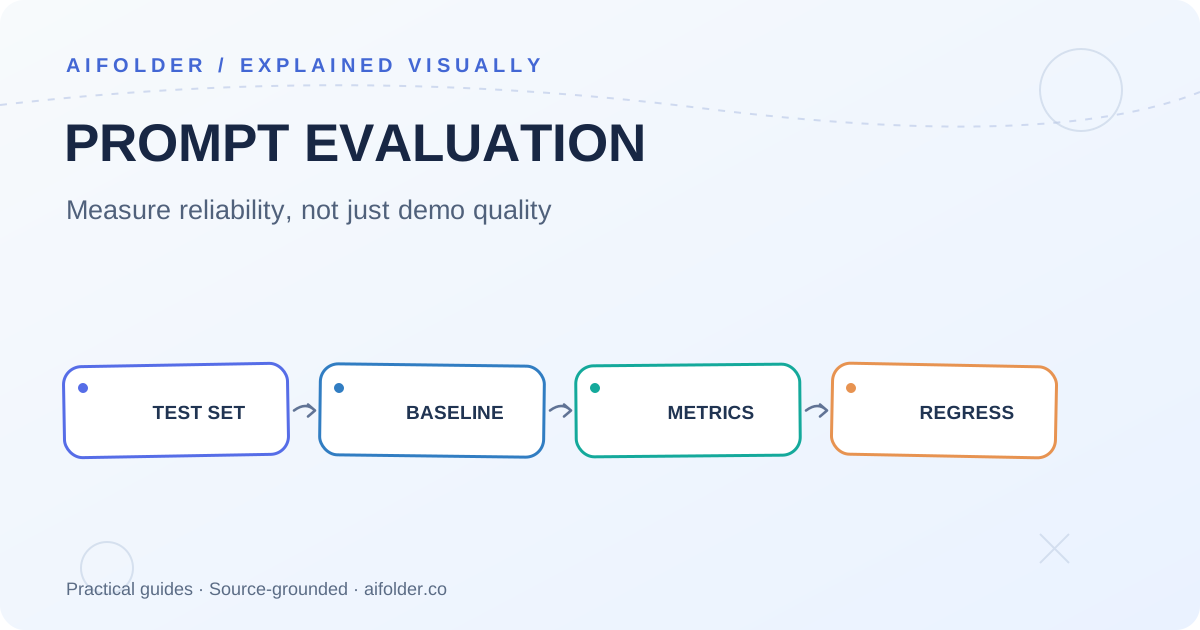
- Keep representative test cases for regressions.
- Measure relevant quality signals: accuracy, task completion, cost, and latency.
- Treat retrieved documents and user content as untrusted input, not higher-priority instructions.
For example, a customer-support classifier can be evaluated with a small labeled set covering ambiguous, multilingual, and adversarial examples. A successful demo with one input is not sufficient evidence that the prompt is reliable.
A reusable starter template
You are helping with [specific task].

Goal:
[Define the outcome.]

Context:
[Include only relevant background.]

Input:
[Insert the material to process.]

Output:
[Specify format, length, fields, or examples.]

Constraints:
[Identify excluded content, accuracy limits, and safety requirements.]

If essential information is missing, say what is missing rather than guessing.
Start with the shortest version that solves the problem. Add detail only when it addresses an observed failure.
Common mistakes to avoid
Vague goals: "Make it better" offers no measurable target. Specify what better means.
Unverified assumptions: Never ask the model to improvise facts you plan to present as verified.
Overstuffed context: More text can dilute useful instructions. Include the context directly relevant to the task.
No evaluation: A single pleasing answer can hide unstable behavior. Test multiple realistic inputs.
Confusing a prompt with security: Prompt text alone does not protect sensitive data or authorize tool actions. Enforce permissions and validation in application code.
Practical exercise
Choose one repeated task—such as generating FAQ answers from product specifications. Make three prompts: direct instruction, structured instruction, and structured instruction with examples. Test each on ten representative inputs. Compare whether outputs use only supplied facts, follow the format, and require manual corrections.
The best prompt is the one that consistently meets your use case, not necessarily the longest.
FAQ
Do I need prompt engineering to use ChatGPT?
Not for simple interactions. Clear instructions help most users, while systematic prompting becomes more important when output must be repeatable.
Is prompt engineering the same as context engineering?
They overlap. Prompt engineering focuses on instructions and examples; context engineering addresses the broader information passed to a model, including retrieved data, conversation state, and tool results.
Will a detailed prompt stop hallucinations?
No. Grounding, verification, task-specific evaluation, and application safeguards are still necessary.
Further reading and sources
- Google web.dev: Prompt engineering
- Google Cloud: What is prompt engineering?
- DAIR: Prompt Engineering Guide
- web.dev: Explore AI use cases
Explore related guides in AiFolder Blog and browse AI tools and resources.