
Research has several jobs
Finding sources, extracting study details and synthesizing conclusions are different tasks. Choose a tool for the job it performs, then keep a path back to the original paper or document. This shortlist is based on official product documentation, not a controlled head-to-head accuracy benchmark.
| Job | Candidate | Evidence to inspect |
|---|---|---|
| Academic paper discovery | Elicit | Relevant papers and original abstracts |
| Citation context | Scite | How later work discusses a claim |
| Reference organization | Zotero | Original metadata and saved documents |
Elicit describes paper search and extraction workflows. Scite organizes citation context. Zotero is a reference-management tool, not an AI answer engine; it is included because a traceable research workflow needs a durable library.
Begin with a question you can falsify
Instead of ask everything about remote work, define the population, intervention, outcome and date window. For an illustrative query, ask whether a particular practice changes measured retention in a specified team setting. Write inclusion criteria before reviewing the first persuasive result.
Search different phrasings and keep the query log. An assistant's first answer may reflect its retrieval choices rather than the full evidence base. Open the papers and check whether the claimed result appears in the methods, results or discussion section.
Turn a broad question into an evidence table
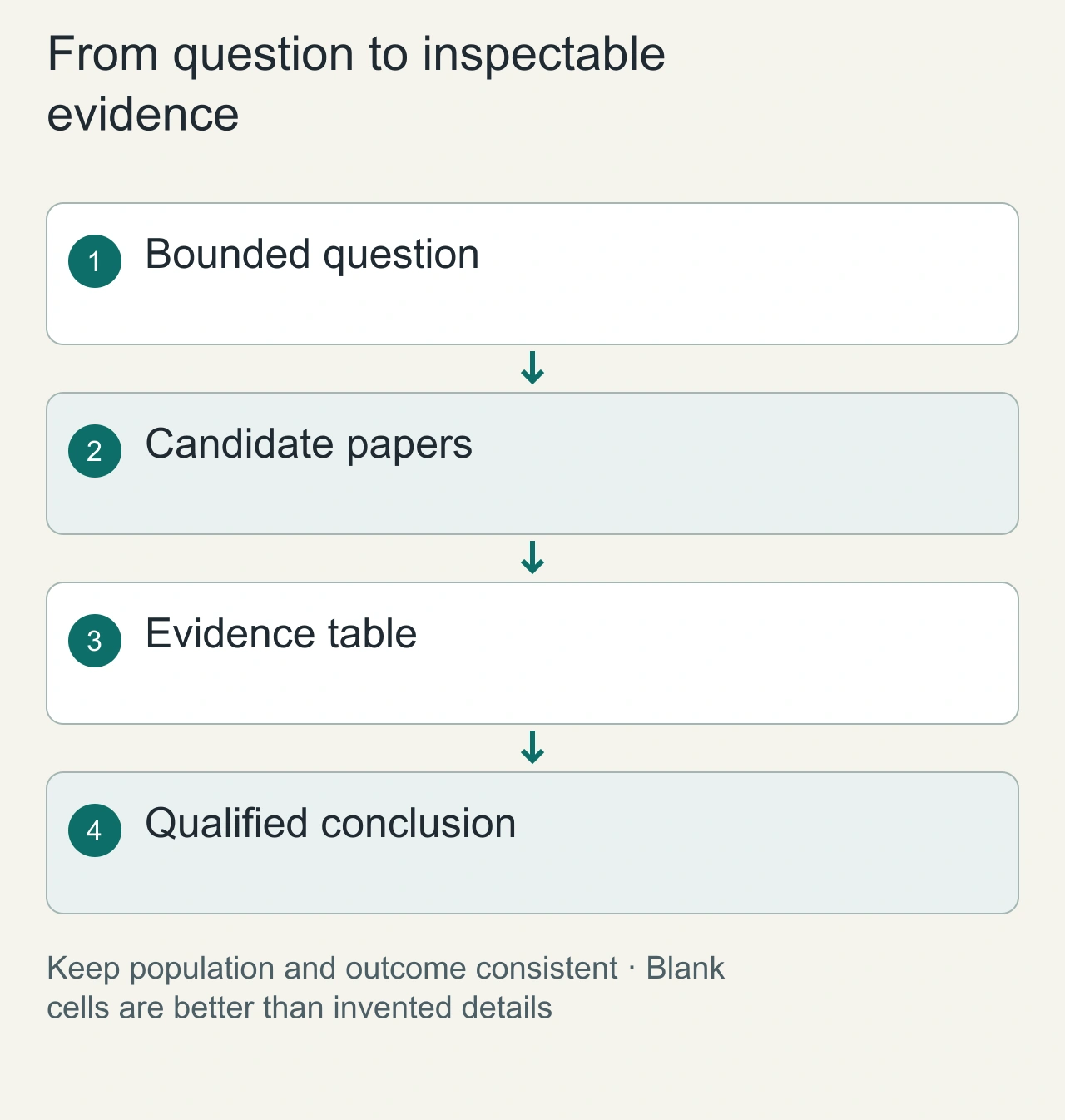
Start with a question that can be answered by a defined body of evidence. For example, replace whether remote work is better with which outcomes changed for a particular occupation and study period. Specify the population, comparison and outcome before searching. Otherwise the assistant can combine productivity, satisfaction and retention into a single persuasive answer that has no consistent meaning.
Create an evidence table with source identifier, study design, sample, measured outcome and limitation. Leave cells blank when the source does not provide the information. Ask an assistant to populate the table from a small set of papers, then manually check several rows against the original text. The table makes disagreement visible instead of smoothing it into prose.
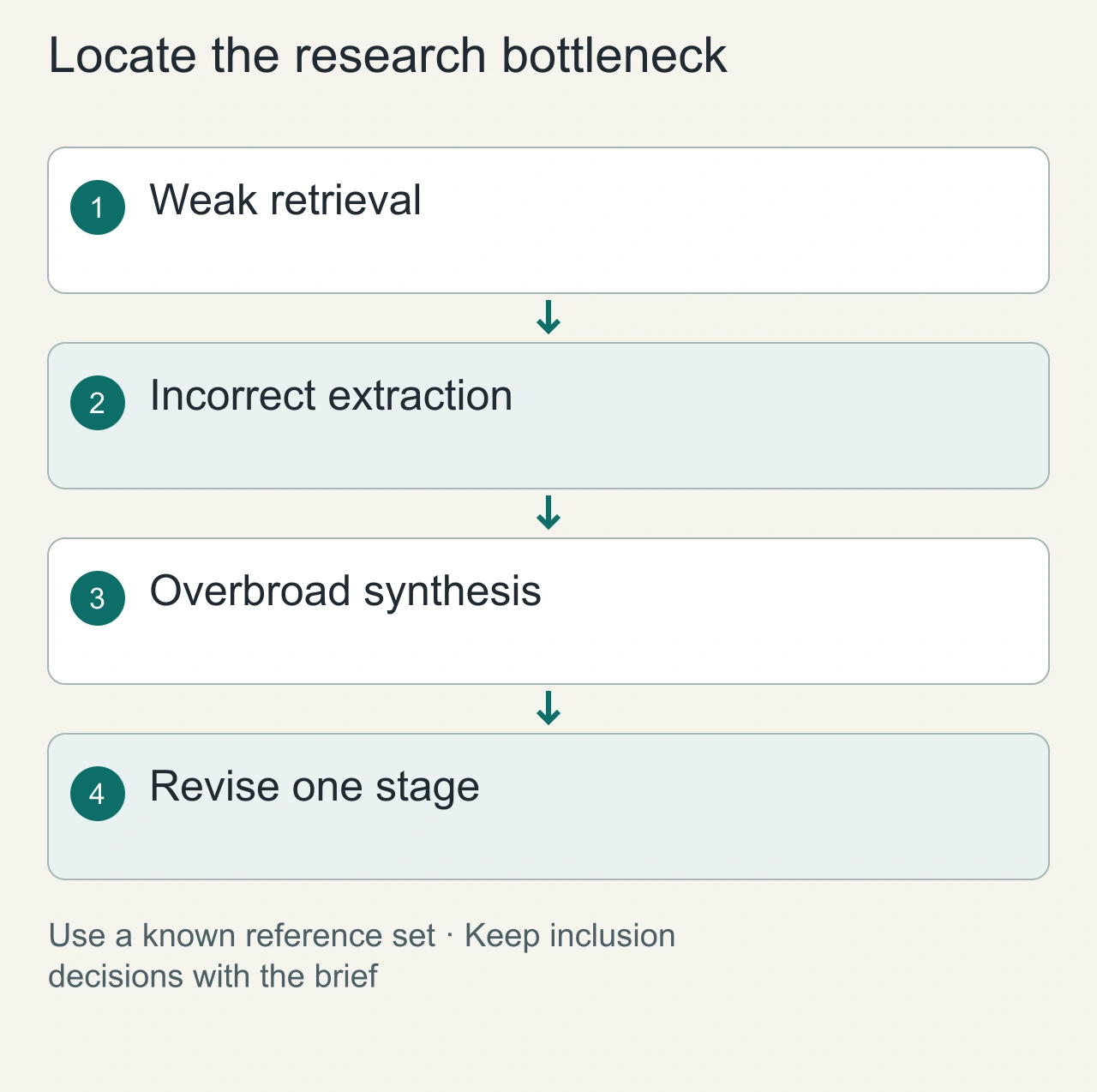
Include one paper that is relevant to the topic but does not support your expected conclusion. A research workflow should preserve that distinction. Retrieval finds candidates; extraction records what they say; interpretation explains how the findings relate. Keep these operations separate so a missed source and a mistaken conclusion can be corrected independently.
A useful extraction fixture includes a source reporting an association and another describing an intervention. Ask for the outcome and study design in separate columns. Then check whether the synthesis turns association into causation. Keep the original language visible beside the proposed conclusion. This is a practical way to expose overstatement without demanding a complete systematic review. If the tool cannot distinguish the designs reliably, use it for candidate discovery while retaining manual extraction for that field. Assigning a narrower role can be more productive than abandoning the entire workflow.
Audit a citation at the claim level
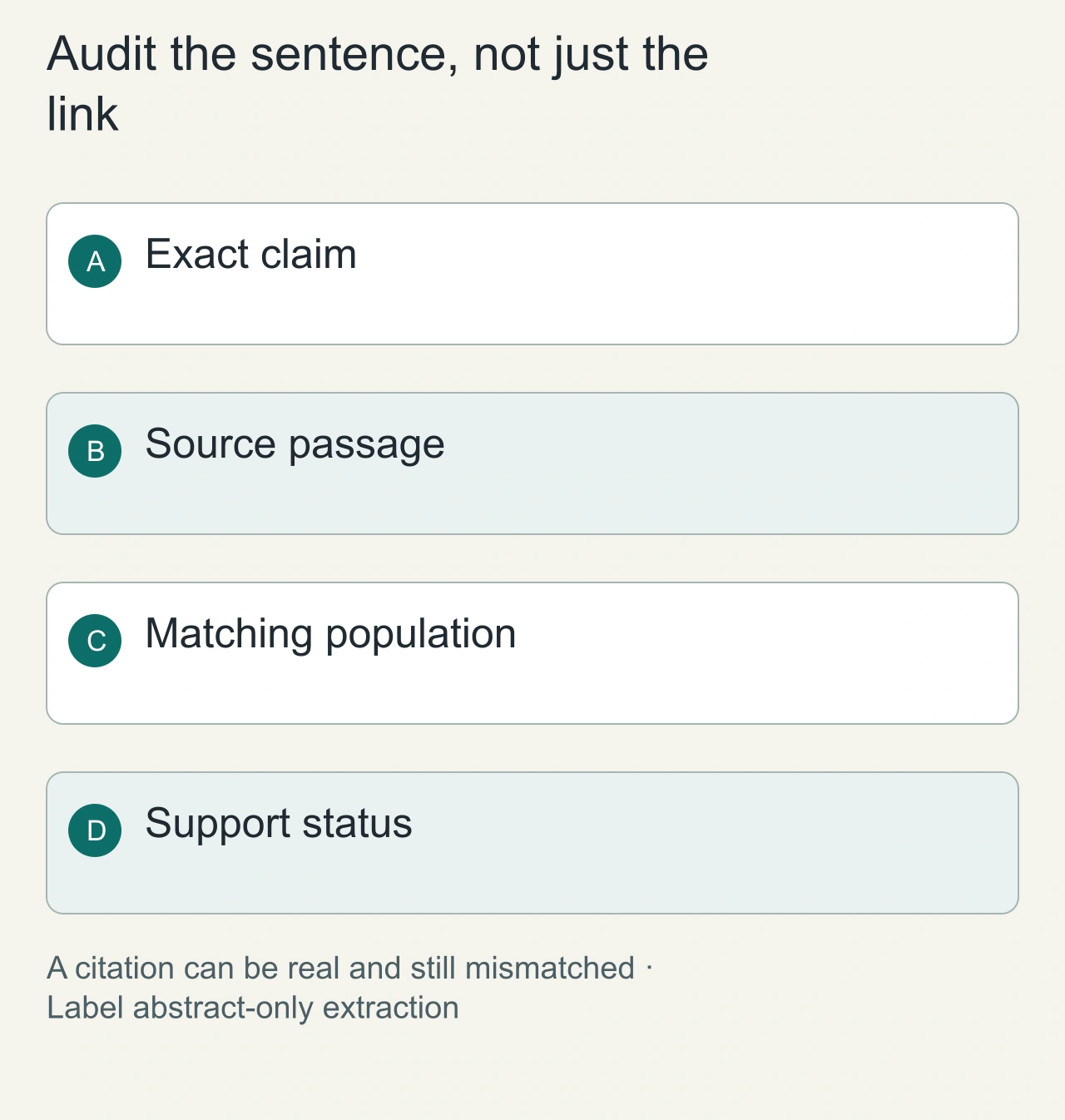
Take one sentence from the generated summary and open its cited source. Find the paragraph, table or figure that is supposed to support it. Check whether the sentence describes the same population and outcome. A paper about one profession should not silently become evidence about all workers. A discussion hypothesis should not become a measured result.
Use a claim ledger with three statuses: directly supported, partly supported and unsupported. For partial support, write the narrower sentence the source permits. This exercise is useful even when every citation resolves successfully. A valid link proves the source exists; it does not prove the associated claim follows from it.
If full text is unavailable, identify the extraction as abstract-based. Do not fill in missing methods from a similar paper or from the assistant's prior knowledge. Check the current vendor's access and workflow limits, such as [Elicit's plan documentation](https://elicit.com/pricing), before starting a larger extraction job. This guide does not promise a particular quota or paid capability.
Separate extraction from interpretation
Use a table containing study design, population, sample size, outcome, uncertainty and limitations. If the tool cannot access the full text, label the row accordingly. A summary based on an abstract should not be represented as a complete review of the study.
A citation is a pointer, not validation. Confirm that it supports the exact sentence, refers to the relevant population and is not being cited merely as background. Conflicting results may come from different methods rather than one source being wrong.
Cost and access boundaries
Elicit's pricing page lists a Basic free plan with limits on particular workflows. Free access does not imply every extraction or report capability is unlimited. Check the active plan before investing in a large review. Scite and connected databases have their own access policies.
Test with a topic whose core papers you already know. Score missed sources, unsupported statements and extraction errors separately. Do not evaluate only the fluency of the final summary.
Explore AiFolder's AI directory and use agent permissions when research tools access private documents.
Diagnose poor research output
When the summary is vague, inspect the query and inclusion criteria before changing models. A broad query often returns background material rather than studies that answer the question. When the summary is precise but incorrect, inspect the extraction rows. When the rows are correct but the conclusion overreaches, revise the synthesis instruction.
Keep a small reference set of papers you already understand. Record which candidates were retrieved and which were missed. Add one extraction field whose correct value is easy to verify, such as study year or sample description. This reveals whether the system is reading the supplied material or substituting a plausible answer.
For a collaborative review, save the search terms, date, inclusion decisions and claim ledger with the final brief. Another person should be able to reconstruct why a source was included and where a conclusion came from. Fluency becomes valuable after this chain is inspectable. It is a presentation quality, rather than a substitute for research evidence.