

Original AiFolder technical editorial illustration; conceptual MoE graphic, not a measured architecture diagram.
Understanding the MoE architecture
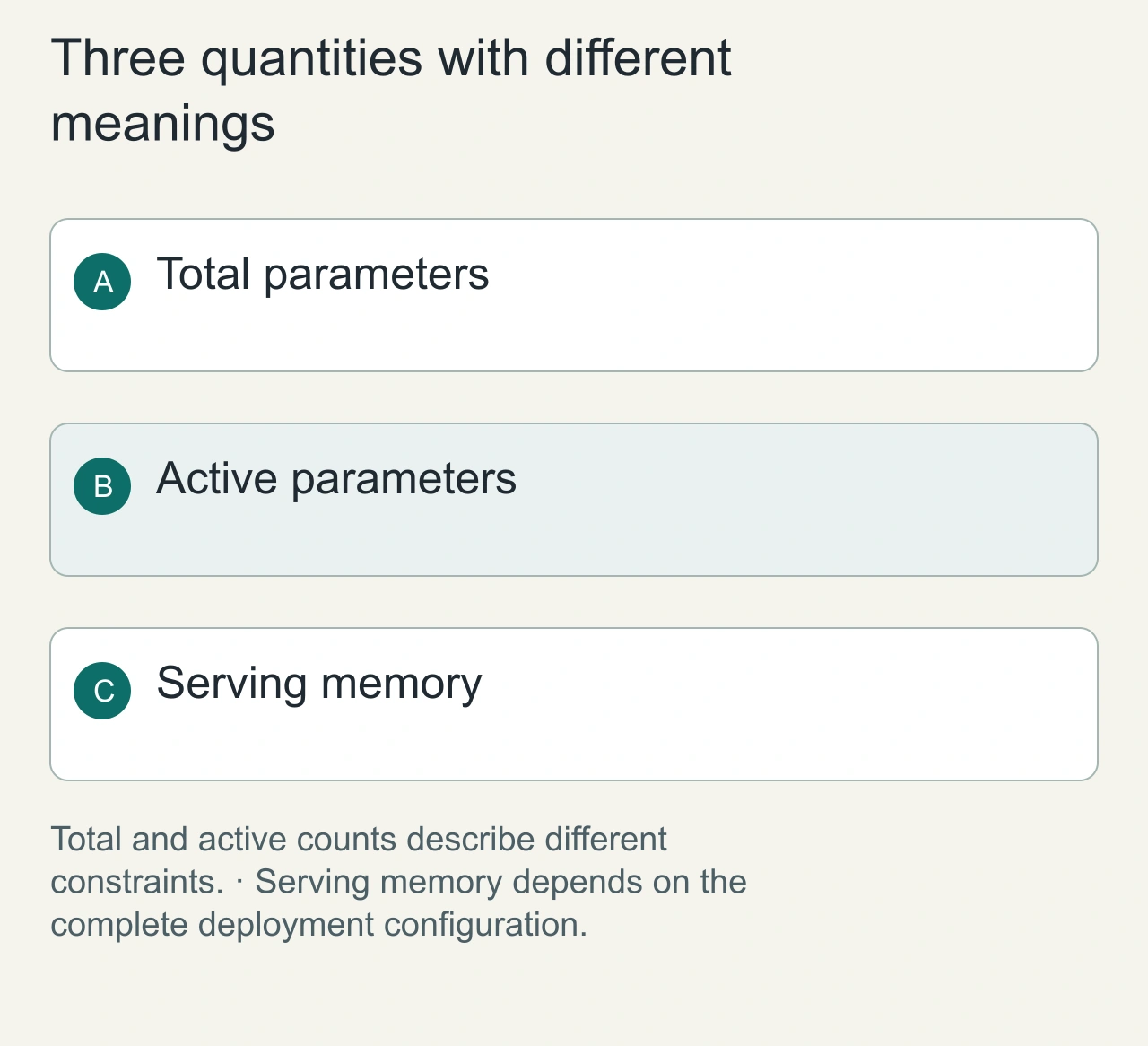
Mixture-of-Experts models contain multiple specialized subnetworks. A routing mechanism selects a subset for each token or processing step. Total parameters describe the full model; active parameters describe the subset used in a forward pass. A lower active count does not mean the whole model fits in memory sized for that count: hosting still requires a strategy for all weights, quantization, expert placement and memory bandwidth. Simplified explanatory diagram, not an official disclosure of ML4's exact routing implementation.
Separate total weights from work per request
Mistral's current model page identifies Large 4 as a granular mixture-of-experts model with 1.05 trillion total parameters and 52 billion active parameters. Those figures describe different aspects of the model. Active parameters help explain the selected computation for a forward pass; total parameters describe the full set of weights the deployment must arrange. A small active fraction should not be interpreted as permission to size the server as though only that fraction existed.
Consider a hypothetical self-hosted document assistant. Before choosing a machine, select the actual model package, precision or quantization, serving engine, context setting, and concurrency. The deployment may distribute experts or apply supported compression, but those are concrete engineering choices with their own behavior. Calculate memory and verify the supported path before writing a hardware recommendation. The cover's open lattice is an editorial metaphor for accessible model structure; it is not an exact architecture diagram or a photograph of the model's internals.
Important source discrepancy: 49B or 52B active?
Mistral's official model documentation currently contains conflicting numbers. Its generic model URL and launch announcement describe 52B active parameters, while its version-specific documentation describes 49B active parameters. Both list 1.05T total parameters and a 1.6B vision encoder. Until the company reconciles these pages, AiFolder should not present one active-parameter count as a settled fact. Primary references: Mistral model page and version-specific page. Checked October 8, 2026.
API features and use cases
The official model documentation lists structured outputs, function calling, document question answering, batching, agents and conversations, and built-in tools. Potential workloads include enterprise retrieval, multilingual document analysis, coding assistance and agent orchestration. Feature listings do not guarantee accuracy on any specific task; benchmark claims must be tied to the tested version and method.
Compare hosted access with self-hosting on the same task
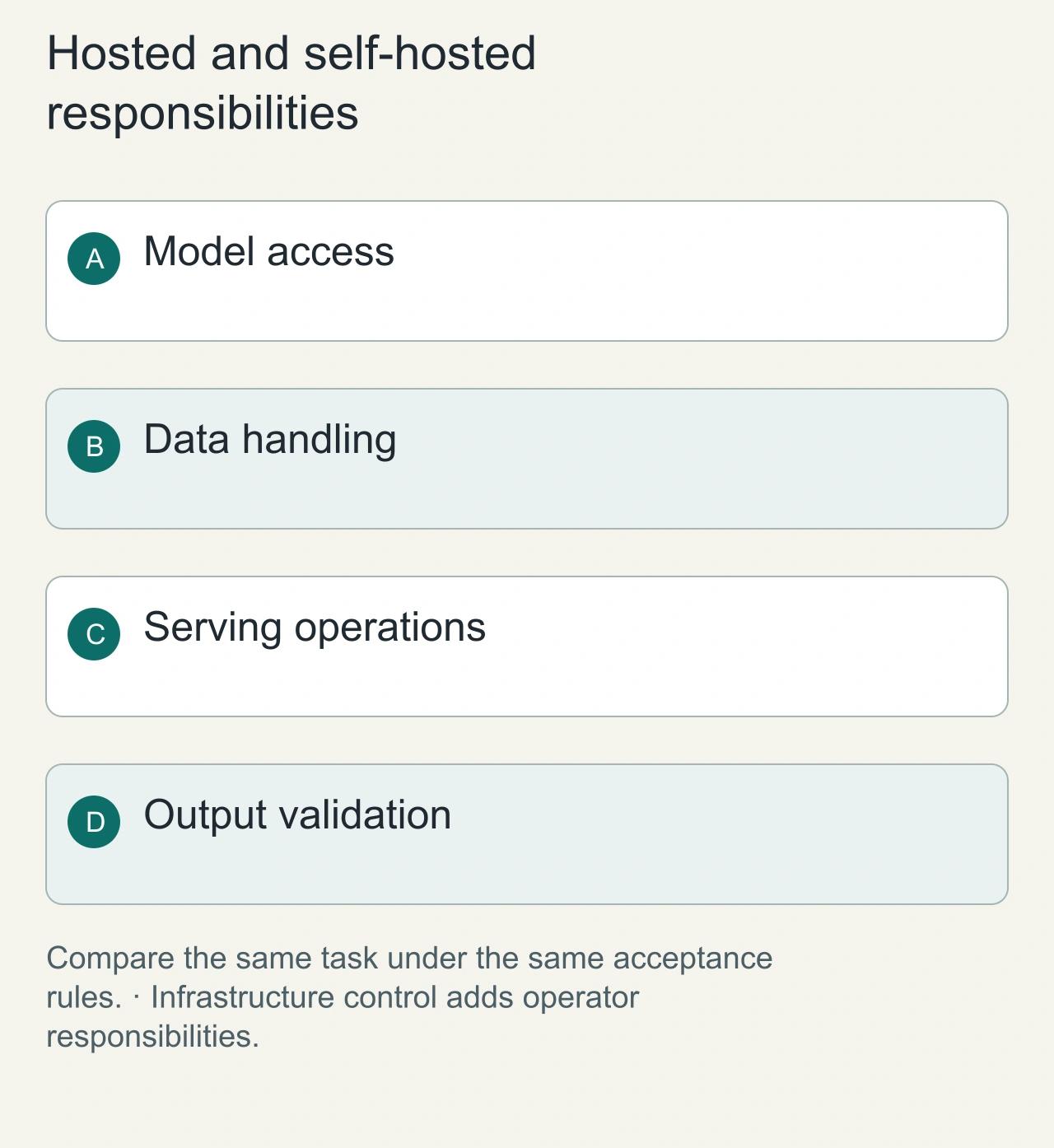
A hosted API can remove much of the model-serving setup, while self-hosting gives an operator control over the environment and introduces operational work. Compare them with one explicit workload, such as extracting fields from a collection of public documents. Keep the schema, input distribution, retry policy, and acceptance criteria the same. A model that produces plausible prose is not necessarily the best fit for a workflow requiring valid structured output and reliable tool arguments.
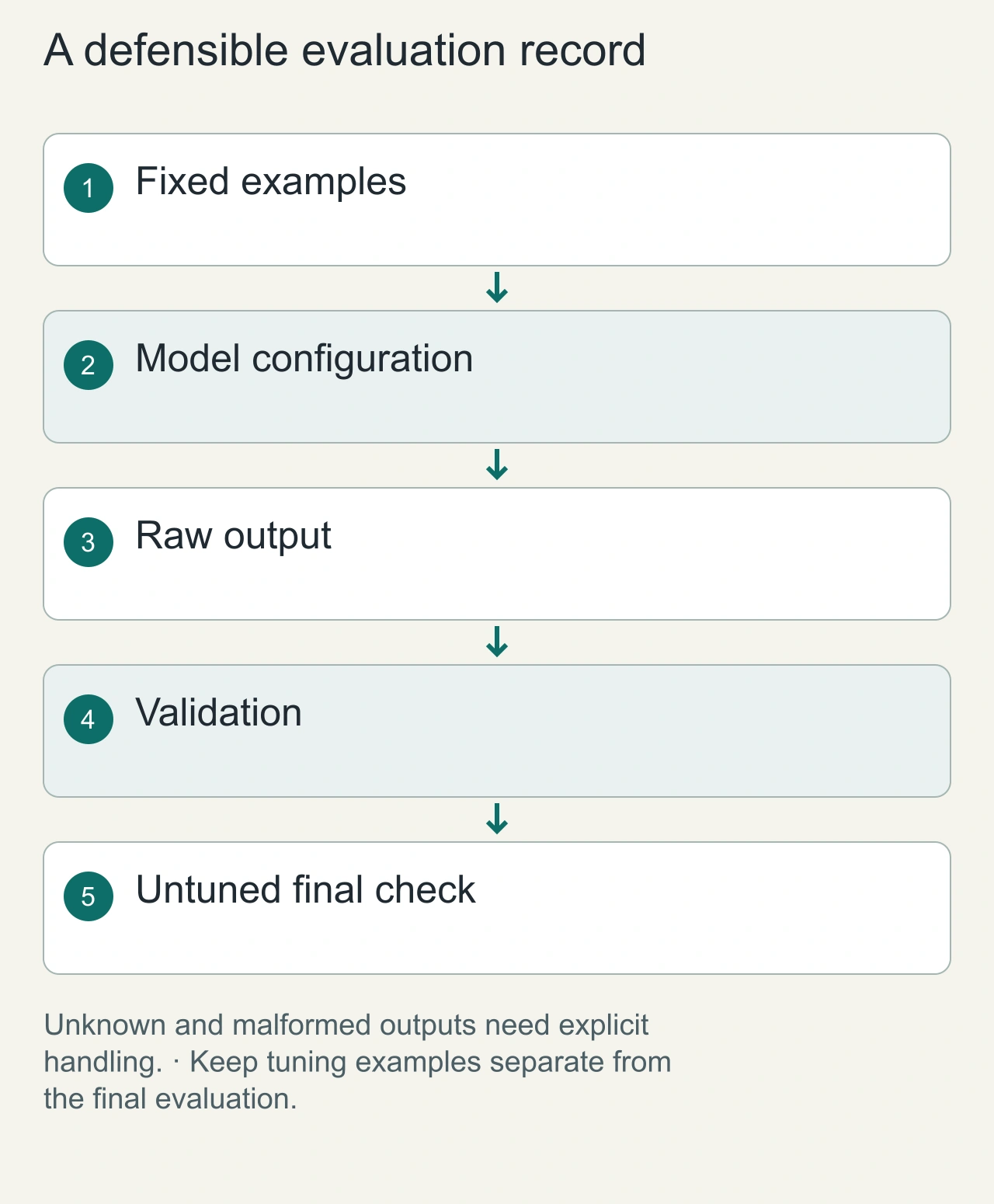
Read the current model documentation for supported features and access conditions instead of assuming that every serving path behaves identically. For our extraction example, preserve the raw result, parse outcome, missing fields, and unsupported inferences. Evaluate the full workflow including validation and retries. We have not run an independent Large 4 API evaluation for this explainer, and vendor benchmark claims should remain labeled as such. The useful conclusion is a list of decisions and tests that your workload needs, not an unsupported claim that a larger parameter count wins.
Preview versus open weights
The public preview is accessible through Mistral's hosted service. Open-weight deployment is a separate milestone expected later in October. Until actual model files, license terms and inference requirements are available, a guide should not claim verified VRAM requirements or tokens-per-second on local hardware.
How to evaluate ML4 responsibly
Use a fixed dataset of representative tasks: structured extraction, long-document retrieval, tool calls, code changes and multilingual questions. Record model version, date, sampling settings, input/output token counts, latency, cost, schema-validity rate and task accuracy. For agent tests, distinguish tool-call correctness from the quality of the final answer. Re-run after preview changes.
Performance claims
Mistral's published benchmark charts are vendor-reported. Some comparisons use different task settings and safety policies, so headline ranks are not sufficient for a general-purpose winner claim. AiFolder has not independently measured ML4 speed, reliability or local inference performance.
Quick answer
Mistral Large 4 entered public API preview on October 6, 2026. It is a multimodal Mixture-of-Experts model with 1.05 trillion total parameters and a documented one-million-token context window. Public model weights are planned for later in October, so local inference measurements are not yet available. The launch matters to teams evaluating controllable AI deployments, agent workflows and multimodal processing. It does not yet establish which model performs best on any particular organization's workloads.
Use failures to define your integration contract
A real integration must know what to do with malformed structured output, an unavailable endpoint, a truncated response, or a model-generated field unsupported by the source. Give each case a distinct status rather than forcing every response into a success shape. For document extraction, an explicit unknown value can be safer and more useful than a guessed value. Make the validation layer responsible for enforcing required fields and allowed types, independently of how confidently the model presents its answer.
Start with a small, documented evaluation set containing ordinary examples, ambiguous wording, long documents, and missing information. Record the model identifier and deployment configuration so a later update can be compared fairly. If you revise the prompt after seeing failures, reserve a separate set for the final check rather than reporting improvements only on examples you tuned against. This approach makes the evaluation useful even when a new release changes the underlying model. It also produces concrete material for a future measured article without disguising today's documentation-based explainer as a benchmark. Record the evaluation date alongside the model identifier because preview access conditions and supported serving paths can change independently of your prompt.
Official references
The primary launch source is Mistral's October 6 announcement. Technical feature details come from Mistral's model documentation and its version-specific page. The two documentation URLs disagree about the number of active parameters. AiFolder records the conflict rather than silently selecting one number. All benchmark comparisons remain vendor-reported until independently reproduced.
What should developers do next?
Start with an evaluation set reflecting your real tasks: long-document retrieval, structured extraction, tool invocation, multilingual queries and coding changes. Record exact API model IDs, version dates, cost, latency, valid-output rate and correctness. Repeat the evaluation when the final weights are released. Do not estimate VRAM needs from active-parameter count alone.
FAQ
Can I download the model today?
The public preview is available through Mistral's API. The company plans a later public weights release.
What does active parameter count mean?
It describes the portion of a Mixture-of-Experts model activated during a processing step, not the complete set of weights required for deployment.
Is the model proven faster than alternatives?
No independent AiFolder performance test has been run. Vendor benchmark charts require methodology-specific interpretation.
Source of truth / References
Primary sources
- Mistral launch announcement, October 6, 2026
- Mistral model documentation
- Mistral version-specific documentation
Secondary sources
None required for the factual launch summary. External comparisons should be separately attributed.
Editorial note
Source conflict over active parameter count remains unresolved. Weight-download instructions, VRAM figures and measured performance are pending.