
Choose the measurement before the tool
SEO research, content production and visibility monitoring answer different questions. A generated article is not evidence that a page ranks, attracts qualified visitors or is cited by an AI answer. Choose tools that expose the data needed for your actual decision.
Ahrefs AI describes its AI-related research and visibility workflows. Semrush AI Visibility focuses on AI-discovery visibility. Their feature descriptions are vendor claims; this article does not present an independent ranking-performance benchmark.
A task-based shortlist
| Task | Data or workflow | Practical result |
|---|---|---|
| Topic prioritization | Search demand and competing pages | A brief with a specific intent |
| Editorial production | Source collection and drafting | An original, verified answer |
| Traditional search monitoring | Queries, impressions and clicks | A trend tied to the published URL |
| AI-search monitoring | Prompts, mentions and cited pages | A dated observation of visibility |
For a product tutorial, collect the actual interface behavior before writing the instructions. A tool that drafts plausible steps can still invent buttons or overstate privacy. Link to the feature only after verifying that the route and workflow exist.
Choose an SEO task with a measurable output
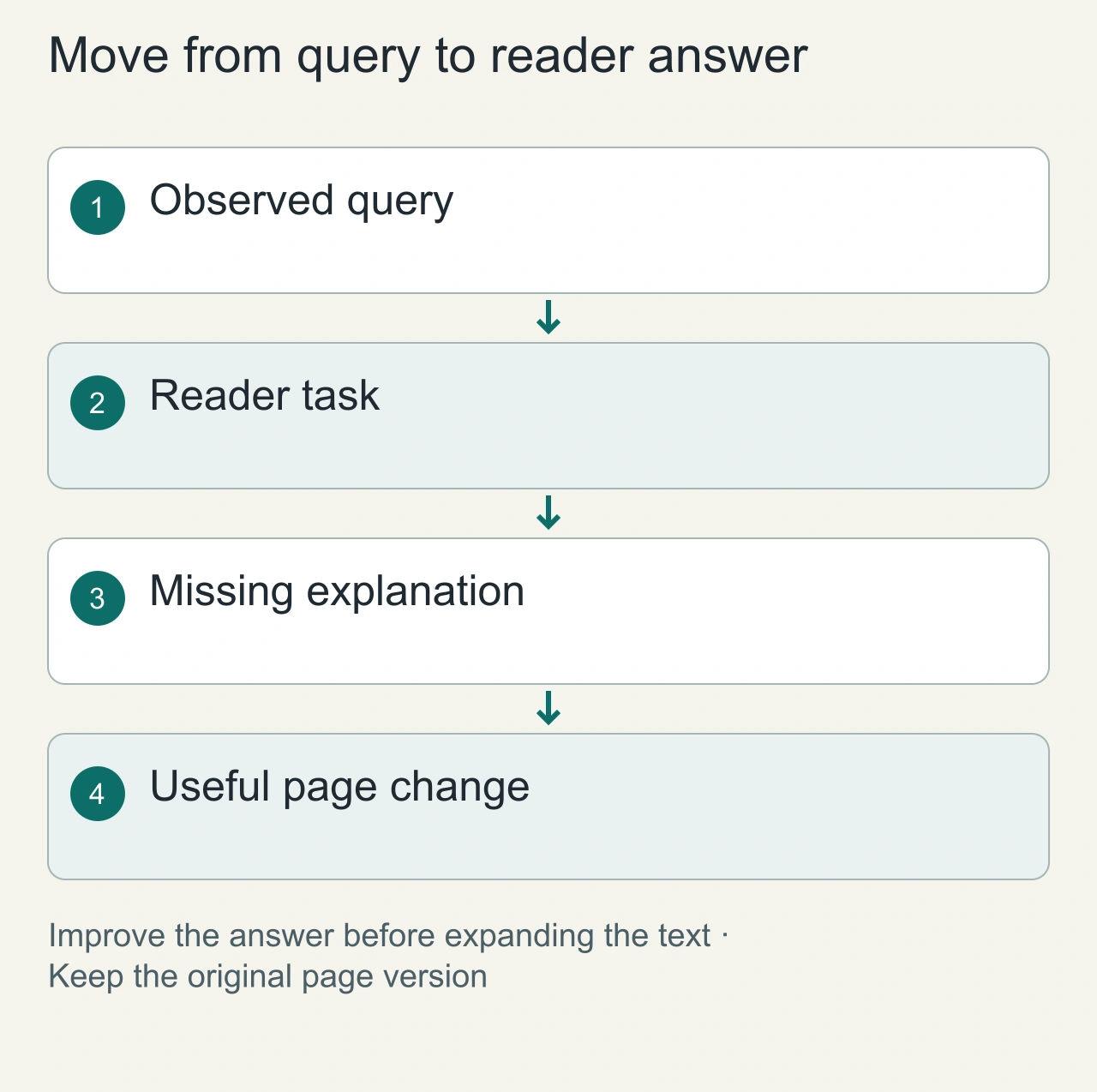
Imagine a JSON tutorial that receives impressions but few useful visits. Before asking an assistant to rewrite it, inspect the queries, the title promise and the first explanation. A formatting query may need an immediate tool link and a small example; a debugging query may need a specific error diagnosis. These are different intents even when the same keyword appears.
Give the assistant the actual page and a limited set of query observations. Ask it to map each query to the passage that answers it, then identify missing explanations. This produces an editorial backlog you can inspect. Asking for an optimized article without a reader task tends to produce longer headings and repeated terms rather than a better answer.
Make one concrete change: add an invalid JSON example, explain the error and show the corrected form. Preserve the original page version and publication date. The result is useful content even before traffic changes. [Google's generative-content guidance](https://developers.google.com/search/docs/fundamentals/using-gen-ai-content) is an appropriate primary reference when deciding how generated material should be reviewed.
For the JSON example, compare the page's opening with a novice's actual next action. Can they identify the invalid character, understand the error and reach the formatter without searching through a general introduction? On mobile, inspect code wrapping and the corrected output. Ask the assistant to flag passages that do not contribute to that journey. Remove them or move them to a supporting explanation. This creates a concrete editorial improvement that can be assessed immediately, while search observations accumulate over time. Keep both kinds of evidence in the revision note.
Separate visibility from content quality
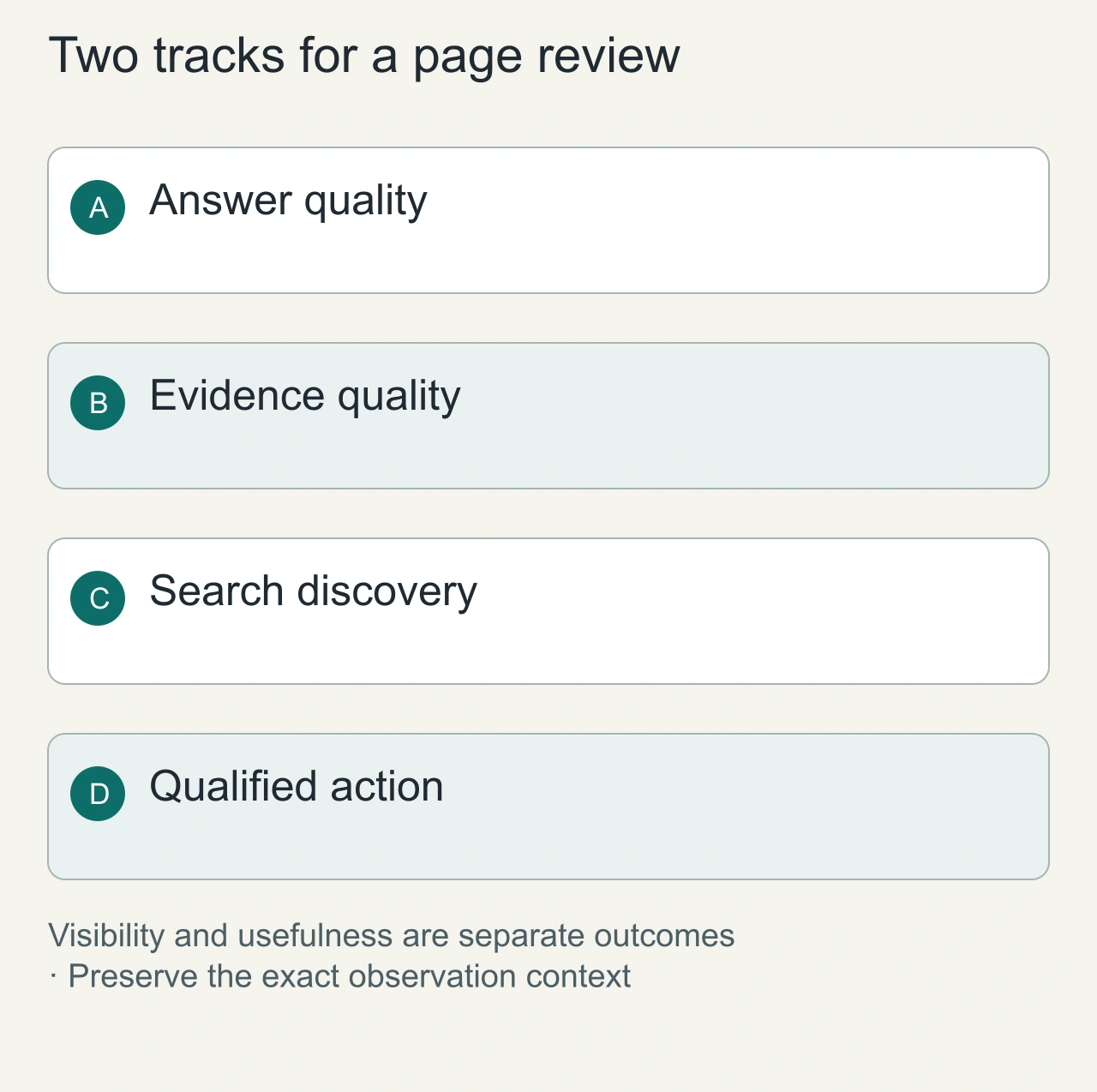
A page can be accurate yet difficult to discover, or visible yet disappointing after the click. Maintain two review tracks. The content track checks examples, sources and whether the promised task can be completed. The discovery track checks crawlability, page titles, internal links and the queries reaching the page. One score cannot explain both.
For an AI-answer observation, save the exact prompt, provider, date and returned answer. Record whether the answer mentions the brand, cites the page or accurately reflects its explanation. Those are different outcomes. Repeat a bounded set of prompts later rather than treating one screenshot as an enduring measure of visibility.
Create a source checklist for every newly added factual claim. If an assistant suggests a performance figure or a current product limit, either verify it or remove it. A polished article with unsupported details can damage the reader's decision even if its title is effective. Do not convert predicted rankings into measured results.
Keep the editorial brief concrete
Write one primary question, the reader's starting point, a reproducible example and the limitations. Include the sources needed for claims that can change. Avoid rephrasing competitor articles without adding original explanation, examples or evidence.
When using a language model, ask it to identify unsupported claims rather than fill every gap with confident prose. A placeholder measurement should remain a placeholder until the measurement is performed.
Evaluate visibility over comparable windows
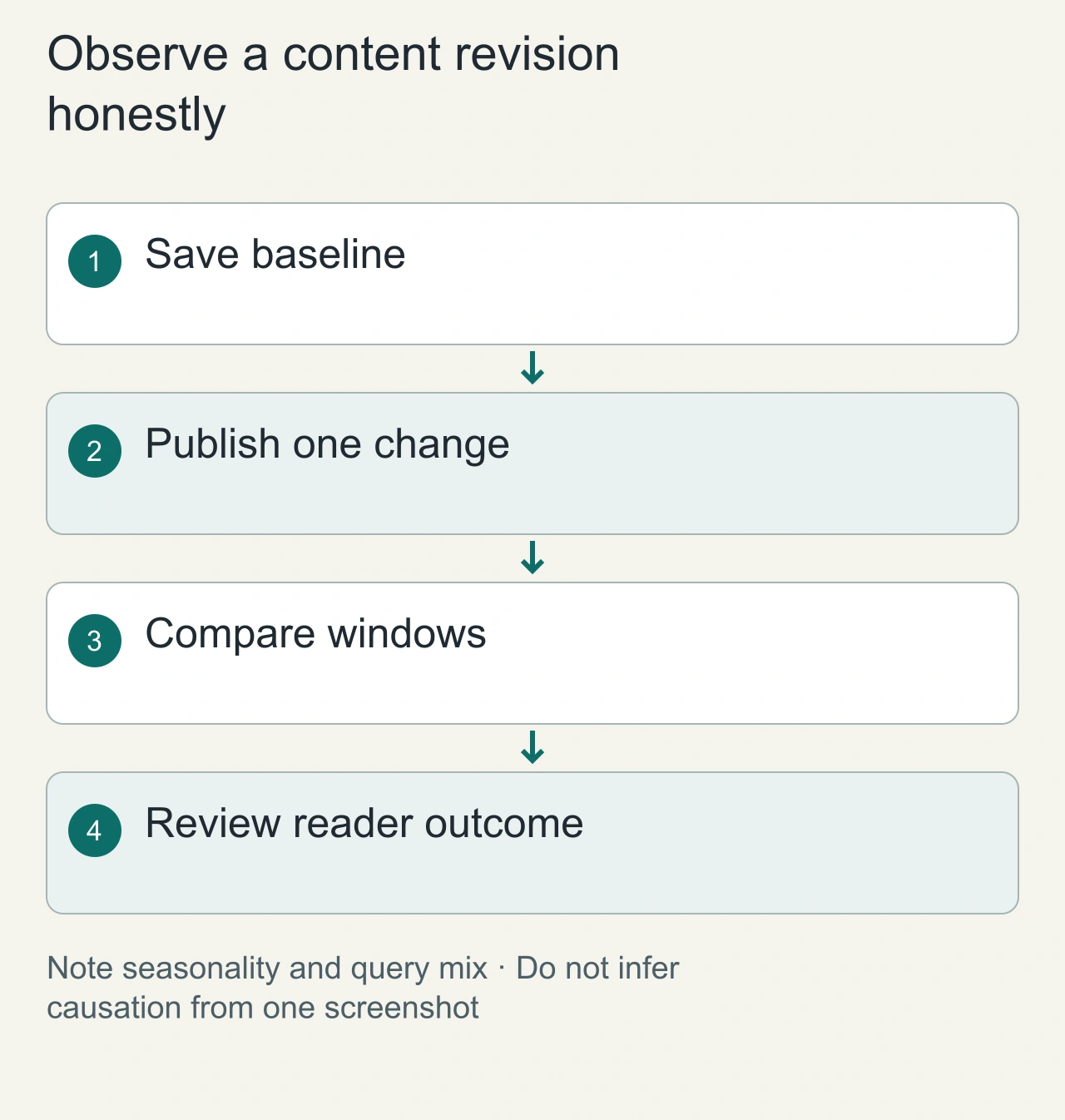
Record publication date, content revision and the URLs being compared. Search traffic varies by season, indexing and query mix. A before/after screenshot alone does not establish that the AI tool caused a gain. Compare impressions, position, click-through rate and qualified actions together.
AI-answer visibility also varies by prompt, geography, provider and date. Keep the observed response and cited page so another person can assess it. A brand mention and a link to the article are different outcomes.
Spend on the bottleneck
If the problem is inaccurate tutorials, another visibility subscription will not fix the content. If the content is useful but you cannot see which queries it serves, measurement may be the better investment. Start with the smallest workflow that resolves the current uncertainty.
Use AiFolder tools for practical examples and browse the AI directory by task. Free trials and paid tiers should be checked on the vendor's live pricing page before purchase.
Evaluate revisions over comparable windows
Record the change date and compare windows with similar length and query intent. Examine impressions, clicks and qualified actions together. A larger impression count with fewer relevant visits may reflect a wider query mix rather than a better page. Keep major site changes and campaign activity in the observation notes.
When a change performs poorly, inspect the task match before adding more generated text. The revised title may attract readers seeking a different answer. A useful example may be too far down the page. A tool link may be unavailable on mobile. These problems are easier to fix when the page review is tied to a concrete reader journey.
Use the AI system to propose alternatives and flag unsupported claims, while keeping the final editorial decision with the page owner. Spend on a measurement product only when it resolves a specific uncertainty you cannot answer with existing data. The objective is an inspectable improvement to a reader task, not a promise that one tool can guarantee a ranking.