SQL Interview Questions and Answers
Practice SQL interview questions and answers organized by difficulty, with revealable explanations and related topics.
Entry questions
3 questions- Question 1Entry
Define a Temp Table
- SQL
Reveal answerHide answer
In a nutshell, a temp table is a temporary storage structure. Basically, you can use a temp table to store datatemporarily so you can manipulate and change it before it reaches its destination format.
- Question 2Entry
What is PRIMARY KEY ?
- SQL
Reveal answerHide answer
A PRIMARY KEY constraint is a unique identifier for a row within a database table. Every table should have a primary key constraint to uniquely identify each row and only one primary key constraint can be created for each table. The primary key constraints are used to enforce entity integrity.
- Question 3Entry
What is a VIEW ?
- SQL
Reveal answerHide answer
A view is simply a virtual table that is made up of elements of multiple physical or “real” tables. Views are most commonly used to join multiple tables together, or control access to any tables existing in background server processes.
Mid questions
18 questions- Question 1Mid
What is the difference between WHERE clause and HAVING clause?
- SQL
Reveal answerHide answer
WHERE clause introduces a condition on individual rows; HAVING clause introduces a condition on aggregations, i.e. results of selection where a single result, such as count, average, min, max, or sum, has been produced frommultiple rows. Your query calls for a second kind of condition (i.e. a condition on an aggregation) hence HAVING works correctly. As a rule of thumb, use WHERE before GROUP BY and HAVING after GROUP BY . It is a rather primitive rule, but it is useful in more than 90% of the cases. While you're at it, you may want to re-write your query using ANSI version of the join: SELECT L.LectID, Fname, Lname FROM Lecturers L JOIN Lecturers_Specialization S ON L.LectID=S.LectID GROUP BY L.LectID, Fname, Lname
HAVING COUNT(S.Expertise)>=ALL
(SELECT COUNT(Expertise) FROM Lecturers_Specialization GROUP BY LectID)
This would eliminate WHERE that was used as a theta join condition.
- Question 1Mid
What’s the difference between_ Azure SQL Database_ andAzure SQL Managed Instance?
- Azure SQL T-SQL
Reveal answerHide answer
With Azure SQL Managed Instance, you essentially get a full-fledged SQL Server that you can control any way you want, just like you would control a locally configured SQL Server. All the power and access and customization you want. With SQL Managed Instance, auditing happens at the server level, because, you are getting the full database server. With, Azure SQL DB PaaS, you are essentially getting a database service, so, you give up a lot of control. Resources dedicated to individual DBs like a container. They are grouped under an Azure SQL Server but that SQL Server is shared.
- Question 2Mid
How a database index can help performance?
- SQL Databases
Reveal answerHide answer
The whole point of having an index is to speed up search queries by essentially cutting down the number of records/rows in a table that need to be examined. An index is a data structure (most commonly a B- tree) that stores the values for a specific column in a table.
- Question 2Mid
Define ACID Properties
- SQL Databases
Reveal answerHide answer
Atomicity: It ensures all-or-none rule for database modifications. Consistency: Data values are consistent across the database. Isolation: Two transactions are said to be independent of one another. Durability: Data is not lost even at the time of server failure.
- Question 3Mid
How can VIEW be used to provide security layer for your app?
- MySQL SQL
Reveal answerHide answer
Views can be used to selectively show limited data to a user. For example consider a Customer table which has columns including name, location and credit card number. As credit card number is a sensitive customer information, it might be required to hide credit card number from a certain database user. As the user can not be given access to entire Customer table, a view with name andlocation of the Customer can be created. The database user can be given access to that view only. This way view provides a security layer ensuring limited access to the database table.
- Question 3Mid
Discuss INNER JOIN ON vs WHERE clause (with multiple FROM tables)
- SQL
Reveal answerHide answer
Problem
You can do: SELECT table1.this, table2.that, table2.somethingelse FROM
table1, table2 WHERE
table1.foreignkey = table2.primarykey
AND (some other conditions)
Or else: SELECT table1.this, table2.that, table2.somethingelse FROM table1 INNER JOIN table2
ON table1.foreignkey = table2.primarykey
WHERE
(some other conditions)
What syntax would you choose and why?
Solution
INNER JOIN is ANSI syntax that you should use. INNER JOIN helps human readability, and that's a top priority. It can also be easily replaced with an OUTER JOIN whenever a need arises. Implicit joins (with multiple FROM tables) become much much more confusing, hard to read, and hard to maintain once you need to start adding more tables to your query. The old syntax, with just listing the tables, and using the WHERE clause to specify the join criteria, is being deprecated in most modern databases.
- Question 4Mid
What’s the difference between_ Azure SQL Database_ andAzure SQL Managed Instance?
- Azure SQL T-SQL
Reveal answerHide answer
With Azure SQL Managed Instance, you essentially get a full-fledged SQL Server that you can control any way you want, just like you would control a locally configured SQL Server. All the power and access and customization you want. With SQL Managed Instance, auditing happens at the server level, because, you are getting the full database server. With, Azure SQL DB PaaS, you are essentially getting a database service, so, you give up a lot of control. Resources dedicated to individual DBs like a container. They are grouped under an Azure SQL Server but that SQL Server is shared.
- Question 5Mid
What is Collation?
- SQL
Reveal answerHide answer
In database systems, Collation specifies how data is sorted and compared in a database. Collation provides the sorting rules, case, and accent sensitivity properties for the data in the database. For example, when you run a query using the ORDER BY clause, collation determines whether or not uppercase letters and lowercase letters are treated the same.
- Question 9Mid
What are the difference between Clustered and a Non- clustered index?
- SQL Databases
Reveal answerHide answer
With a Clustered index the rows are stored physically on the disk in the same order as the index. Therefore, there can be only one clustered index. A clustered index means you are telling the database to store close values actually close to one another on the disk. With a Non Clustered index there is a second list that has pointers to the physical rows. You can have many non clustered indices, although each new index will increase the time it takes to write new records. It is generally faster to read from a clustered index if you want to get back all the columns. You do not have to go first to the index and then to the table. Writing to a table with a clustered index can be slower, if there is a need to rearrange the data.
- Question 10Mid
Describe the difference between truncate and delete
- SQL
Reveal answerHide answer
Delete command removes the rows from a table based on the condition that we provide with a WHERE clause. Truncate will actually remove all the rows from a table and there will be no data in the table after we run the truncate command.
- Question 11Mid
What is the difference between INNER JOIN , OUTER JOIN , FULL OUTER JOIN ?
- SQL
Reveal answerHide answer
An inner join retrieve the matched rows only. Whereas an outer join retrieve the matched rows from one table and all rows in other table ....the result depends on which one you are using: Left: Matched rows in the right table and all rows in the left table Right: Matched rows in the left table and all rows in the right table or Full: All rows in all tables. It doesn't matter if there is a match or not Inner Join Retrieve the matched rows only, that is, A intersect B .
SELECT * FROM dbo.Students S INNER JOIN dbo.Advisors A ON S.Advisor_ID = A.Advisor_ID Left Outer Join Select all records from the first table, and any records in the second table that match the joined keys. SELECT * FROM dbo.Students S LEFT JOIN dbo.Advisors A ON S.Advisor_ID = A.Advisor_ID Full Outer Join Select all records from the second table, and any records in the first table that match the joined keys.
SELECT * FROM dbo.Students S FULL JOIN dbo.Advisors A ON S.Advisor_ID = A.Advisor_ID
- Question 12Mid
What's the difference between a Primary Key and a Unique Key?
- SQL Databases
Reveal answerHide answer
Primary Key: There can only be one primary key in a table In some DBMS it cannot be NULL - e.g. MySQL adds NOT NULL Primary Key is a unique key identifier of the record Primary key can be created on multiple columns (composite primary key) Unique Key: Can be more than one unique key in one table Unique key can have NULL values It can be a candidate key Unique key can be NULL ; multiple rows can have NULL values and therefore may not be considered "unique" Difference between Primary Key and Unique key
- Behavior: Primary Key is used to identify a row (record) in a table, whereas Unique-key is to prevent duplicate values in a column (with the exception of a null entry).
- Indexing: By default SQL-engine creates Clustered Index on primary-key if not exists and Non-Clustered Index on Unique-key.
- Nullability: Primary key does not include Null values, whereas Unique-key can.
- Existence: A table can have at most one primary key, but can have multiple Unique-key.
- Modifiability: You can’t change or delete primary values, but Unique-key values can.
- Question 13Mid
What is Denormalization?
- SQL Databases
Reveal answerHide answer
It is the process of improving the performance of the database by adding redundant data.
- Question 14Mid
How to select first 5 records from a table?
- SQL
Reveal answerHide answer
-- SQL Server SELECT TOP 5 * FROM EMP; -- Oracle SELECT * FROM EMP WHERE ROWNUM <= 5; -- Generic SELECT name FROM EMPLOYEE o WHERE (SELECT count(*) FROM EMPLOYEE i WHERE i.name < o.name) < 5 - Question 15Mid
What is the difference between WHERE clause and HAVING clause?
- SQL
Reveal answerHide answer
WHERE clause introduces a condition on individual rows; HAVING clause introduces a condition on aggregations, i.e. results of selection where a single result, such as count, average, min, max, or sum, has been produced frommultiple rows. Your query calls for a second kind of condition (i.e. a condition on an aggregation) hence HAVING works correctly. As a rule of thumb, use WHERE before GROUP BY and HAVING after GROUP BY . It is a rather primitive rule, but it is useful in more than 90% of the cases. While you're at it, you may want to re-write your query using ANSI version of the join: SELECT L.LectID, Fname, Lname FROM Lecturers L JOIN Lecturers_Specialization S ON L.LectID=S.LectID GROUP BY L.LectID, Fname, Lname
HAVING COUNT(S.Expertise)>=ALL
(SELECT COUNT(Expertise) FROM Lecturers_Specialization GROUP BY LectID)
This would eliminate WHERE that was used as a theta join condition.
- Question 16Mid
How a database index can help performance?
- SQL Databases
Reveal answerHide answer
The whole point of having an index is to speed up search queries by essentially cutting down the number of records/rows in a table that need to be examined. An index is a data structure (most commonly a B- tree) that stores the values for a specific column in a table.
- Question 19Mid
What is the difference between UNION and UNION ALL ?
- SQL
Reveal answerHide answer
UNION removes duplicate records (where all columns in the results are the same), UNION ALL does not. There is a performance hit when using UNION instead of UNION ALL , since the database server must do additional work to remove the duplicate rows, but usually you do not want the duplicates (especially when developing reports). UNION Example: SELECT 'foo' AS bar UNION SELECT 'foo' AS bar Result: +
-----+
| bar |
+
-----+
| foo |
+
-----+
1 row in set (0.00 sec)
UNION ALL example: SELECT 'foo' AS bar UNION ALL SELECT 'foo' AS bar Result: +
-----+ | bar | + -----+ | foo | | foo | + -----+ 2 rows in set (0.00 sec) - Question 20Mid
What is the difference between JOIN and UNION ?
- SQL
Reveal answerHide answer
UNION puts lines from queries after each other, while JOIN makes a cartesian product and subsets it -- completely different operations. Trivial example of UNION : mysql> SELECT 23 AS bah -> UNION
-> SELECT 45 AS bah;
+
-----+
| bah |
+
-----+
| 23 |
| 45 |
+
-----+
2 rows in set (0.00 sec)
similary trivial example of JOIN : mysql> SELECT * FROM
-> (SELECT 23 AS bah) AS foo
-> JOIN
-> (SELECT 45 AS bah) AS bar
-> ON (33=33);
+
-----+-----+
| foo | bar |
+
-----+-----+
| 23 | 45 |
+
-----+-----+
1 row in set (0.01 sec)
Expert questions
7 questions- Question 1Expert
What is Optimistic Locking and Pessimistic Locking?
- SQL Databases
Reveal answerHide answer
In Short: Optimistic assumes that nothing's going to change while you're reading it. Pessimistic assumes that something will and so locks it. Detailed answer: Optimistic Locking is a strategy where you read a record, take note of a version number (other methods to do this involve dates, timestamps or checksums/hashes) and check that the version hasn't changed before you write the record back. When you write the record back you filter the update on the version to make sure it's atomic. (i.e. hasn't been updated between when you check the version and write the record to the disk) and update the version in one hit. If the record is dirty (i.e. different version to yours) you abort the transaction and the user can re-start it. This strategy is most applicable to high-volume systems and three-tier architectures where you do not necessarily maintain a connection to the database for your session. In this situation, the client cannot actually maintain database locks as the connections are taken from a pool and you may not be using the same connection from one access to the next. Pessimistic Locking is when you lock the record for your exclusive use until you have finished with it. It has much better integrity than optimistic locking but requires you to be careful with your application design to avoid Deadlocks. To use pessimistic locking you need either a direct connection to the database (as would typically be the case in a two tier client server application) or an externally available transaction ID that can be used independently of the connection. The disadvantage of pessimistic locking is that a resource is locked from the time it is first accessed in a transaction until the transaction is finished, making it inaccessible to other transactions during that time.
- Question 3Expert
What is the difference between B-Tree , R-Tree and Hash indexing?
- SQL Databases
Reveal answerHide answer
BTree (in fact B*Tree) is an efficient ordered key-value map. Meaning: given the key, a BTree index can quickly find a record, a BTree can be scanned in order. it's also easy to fetch all the keys (and records) within a range. e.g. "all events between 9am and 5pm", "last names starting with 'R'" RTree is a spatial index which means that it can quickly identify close values in 2 or more dimensions. It's used in geographic databases for queries such as:
all points within X meters from (x,y)
Hash is an unordered key-value map. It's even more efficient than a BTree: O(1) instead of O(log n) . But it
doesn't have any concept of order so it can't be used for sort operations or to fetch ranges.
- Question 4Expert
What is Index Cardinality and why does it matter?
- Databases MongoDB SQL
Reveal answerHide answer
The Index Cardinality refers to how many possible values there are for a field. Imagine we have a collection of all humans on earth with the following field:
- "sex"
// 99.9% of the time "male" or "female", but string nonetheless (not binary)
- "name"
- "phone"
- "email"
The field sex only has two possible values. It has a very low cardinality. Other fields such as names, usernames, phone numbers, emails , etc. will have a more unique value for every document in the collection, which is considered high cardinality. It's a rule of thumb to create indexes on high-cardinality keys or put high-cardinality keys first in the compound index. Why? The greater the cardinality of a field the more helpful an index will be, because indexes narrow the search space, making it a much smaller set. Suppose you have an index on sex and are looking for men named John. You would only narrow down the resulting space by approximately %50 if you indexed by sex first. Conversely, if you indexed by name , you would immediately narrow down the result set to a minute fraction of users named John, and then you would refer to those documents to check the gender.
- Question 9Expert
What is Optimistic Locking and Pessimistic Locking?
- SQL Databases
Reveal answerHide answer
In Short: Optimistic assumes that nothing's going to change while you're reading it. Pessimistic assumes that something will and so locks it. Detailed answer: Optimistic Locking is a strategy where you read a record, take note of a version number (other methods to do this involve dates, timestamps or checksums/hashes) and check that the version hasn't changed before you write the record back. When you write the record back you filter the update on the version to make sure it's atomic. (i.e. hasn't been updated between when you check the version and write the record to the disk) and update the version in one hit. If the record is dirty (i.e. different version to yours) you abort the transaction and the user can re-start it. This strategy is most applicable to high-volume systems and three-tier architectures where you do not necessarily maintain a connection to the database for your session. In this situation, the client cannot actually maintain database locks as the connections are taken from a pool and you may not be using the same connection from one access to the next. Pessimistic Locking is when you lock the record for your exclusive use until you have finished with it. It has much better integrity than optimistic locking but requires you to be careful with your application design to avoid Deadlocks. To use pessimistic locking you need either a direct connection to the database (as would typically be the case in a two tier client server application) or an externally available transaction ID that can be used independently of the connection. The disadvantage of pessimistic locking is that a resource is locked from the time it is first accessed in a transaction until the transaction is finished, making it inaccessible to other transactions during that time.
- Question 18Expert
Name some disadvantages of a Hash index
- SQL Databases
Reveal answerHide answer
Hash tables are not sorted data structures, and there are many types of queries that hash indexes can not even help with. For instance, suppose you want to find out all of the employees who are less than 40 years old. How could you do that with a hash table index? Well, it’s not possible because a hash table is only good for looking up key-value pairs – which means queries that check just for equality.
- Question 19Expert
What are some other types of Indexes (vs B-Trees)?
- SQL Databases
Reveal answerHide answer
Indexes that use a R-tree data structure are commonly used to help with spatial problems. For instance, a query like “Find all of the Starbucks within 2 kilometers of me” would be the type of query that could show enhanced performance if the database table uses a R-tree index. Another type of index is a bitmap index, which works well on columns that contain Boolean values (like true and false), but many instances of those values – basic columns with low selectivity.
- Question 20Expert
How does database Indexing work?
- SQL Databases
Reveal answerHide answer
Indexing is a way of sorting a number of records on multiple fields. Creating an index on a field in a table creates another data structure (stored on the disc) which holds the field value, and a pointer to the record it relates to. This index structure is then sorted, allowing Binary Searches to be performed on it, which has log2 N
block accesses. Also since the data is sorted given a non-key field, the rest of the table doesn’t need to be searched for duplicate values, once a higher value is found. The whole point of having an index is to speed up search queries by essentially cutting down the number of records/rows in a table that need to be examined. An index is a data structure (most commonly a B- tree or hash table) that stores the values for a specific column in a table. Given the nature of a binary search, the cardinality or uniqueness of the data is important. Indexing on a field with a cardinality of 2 would split the data in half, whereas a cardinality of 1,000 would return approximately 1,000 records.
Junior questions
5 questions- Question 4Junior
What is FOREIGN KEY ?
- SQL
Reveal answerHide answer
FOREIGN KEY constraint prevents any actions that would destroy links between tables with the corresponding data values. A foreign key in one table points to a primary key in another table. Foreign keys prevent actions that would leave rows with foreign key values when there are no primary keys with that value. The foreign key constraints are used to enforce referential integrity.
- Question 5Junior
What is the difference between Data Definition Language (DDL) and Data Manipulation Language (DML)?
- MySQL SQL T-SQL Databases
Reveal answerHide answer
Data definition language (DDL) commands are the commands which are used to define the database. CREATE, ALTER, DROP and TRUNCATE are some common DDL commands. Data manipulation language (DML) commands are commands which are used for manipulation or modification of data. INSERT, UPDATE and DELETE are some common DML commands.
- Question 6Junior
What is the difference between TRUNCATE and DELETE ?
- MySQL SQL
Reveal answerHide answer
DELETE is a Data Manipulation Language(DML) command. It can be used for deleting some specified rows from a table. DELETE command can be used with WHERE clause. TRUNCATE is a Data Definition Language(DDL) command. It deletes all the records of a particular table. TRUNCATE command is faster in comparison to DELETE. While DELETE command can be rolled back, TRUNCATE can not be rolled back in MySQL.
- Question 7Junior
What is DEFAULT ?
- SQL
Reveal answerHide answer
Default allows to add values to the column if the value of that column is not set. Default can be defined on number and datetime fields. They cannot be defined on timestamp and IDENTITY columns.
- Question 8Junior
What is Normalisation?
- SQL Databases
Reveal answerHide answer
Normalization is basically to design a database schema such that duplicate and redundant data is avoided. If the same information is repeated in multiple places in the database, there is the risk that it is updated in one place but not the other, leading to data corruption. There is a number of normalization levels from 1. normal form through 5. normal form. Each normal form describes how to get rid of some specific problem. By having a database with normalization errors, you open the risk of getting invalid or corrupt data into the database. Since data "lives forever" it is very hard to get rid of corrupt data when first it has entered the database.
Senior questions
11 questions- Question 5Senior
How can we transpose a table using SQL (changing rows to column or vice-versa)?
- SQL
Reveal answerHide answer
A transposition is to rotate information from one row or column to another to change the data layout, for the purpose of making observations from a new perspective.
Method 1: case when subquery + grouping & aggregation Select year, max(Q1) 'Q1', max(Q2) 'Q2', max (Q3) 'Q3', max (Q4) 'Q4'
from (
select year,
case when quarter = 'Q1' then amount end Q1,
case when quarter = 'Q2' then amount end Q2,
case when quarter = 'Q3' then amount end Q3,
case when quarter = 'Q4' then amount end Q4
from zz11
) t group by year;
Method 2: sum if + grouping & aggregation
SELECT year,
MAX(IF(quarter = 'Q1', amount, null)) AS 'Q1',
MAX (IF(quarter = 'Q2', amount, null)) AS 'Q2',
MAX (IF(quarter = 'Q3', amount, null)) AS 'Q3',
MAX (IF(quarter = 'Q4', amount, null)) AS 'Q4'
FROM zz11 GROUP BY year;
Other methods include WITH ROLLUP + grouping & aggregation and UNION + grouping & aggregation, etc. They are essentially the same: calculate the year value after grouping, and generate new columns Q1-Q4 through enumeration and their values through aggregation.
- Question 6Senior
How to generate row number in SQL without ROWNUM
- SQL
Reveal answerHide answer
Consider: SELECT name, sal, (SELECT COUNT(*) FROM EMPLOYEE i WHERE o.name >= i.name) row_num FROM EMPLOYEE o order by row_num
- Question 7Senior
How does B-trees Index work?
- Databases SQL
Reveal answerHide answer
The main reason for the existence of B-Tree Indexes is to better utilize the behaviour of devices that read and write large chunks of data. Two properties are important to make the B-Tree better than binary trees when data has to be stored on disk: Access to disk is really slow (compared to memory or caches, random access to data on disk is orders of magnitude slower); and Every single read causes a whole sector to be loaded from the drive - assuming a sector size of 4K, this means 1000 integers, or tens of some larger objects you're storing. Hence, we can use the pros of the second fact, while also minimizing the cons - i.e. number of disk accesses. So, instead of just storing a single number in every node that tells us if we should continue to the left or to the right, we can create a bigger index that tells us if we should continue to the first 1/100, to the second or to the 99-th (imagine books in a library sorted by their first letter, then by the second, and so on). As long as all this data fits on a single sector, it will be loaded anyway, so we might as well use it completely.
This results in roughly logb N lookups, where N is the number of records. This number, while asymptotically the same as log2 N, is actually a few times smaller with large enough N and b - and since we're talking about storing data to disk for use in databases, etc., the amount of data is usually large enough to justify this.
- Question 7Senior
Explain the difference between Exclusive Lock and Update Lock
- SQL Databases
Reveal answerHide answer
In case of Exclusive lock, no other lock can be acquired on that row or table. Every process has to wait until the process which holds the lock releases it. In case of Update lock, while reading the row or a record, you can have any other lock associated with that row or record. In case of updating the record, update lock changes itself to an exclusive lock and no other process can obtain a lock on that row until the lock is released.
- Question 8Senior
What is faster, one big query or many small queries?
- MySQL SQL
Reveal answerHide answer
What would address your question is the subject JOIN DECOMPOSITION. You can decompose a join by running multiple single-table queries instead of a multitable join, and then performing the join in the application. For example, instead of this single query: SELECT * FROM tag JOIN tag_post ON tag_post.tag_id = tag.id JOIN post ON tag_post.post_id = post.id
WHERE tag.tag = 'mysql';You might run these queries:
SELECT * FROM tag WHERE tag = 'mysql';
SELECT * FROM tag_post WHERE tag_id=1234;
SELECT * FROM post WHERE post.id IN (123,456,567,9098,8904);
Why on earth would you do this? It looks wasteful at first glance, because you've increased the number of queries without getting anything in return. However, such restructuring can actually give significant performance advantages: Caching can be more efficient. Many applications cache "objects" that map directly to tables. In this example, if the object with the tag mysql is already cached, the application will skip the first query. If you find posts with an ID of 123, 567, or 908 in the cache, you can remove them from the IN() list. The query cache might also benefit from this strategy. If only one of the tables changes frequently, decomposing a join can reduce the number of cache invalidations. Executing the queries individually can sometimes reduce lock contention Doing joins in the application makes it easier to scale the database by placing tables on different servers. The queries themselves can be more efficient. In this example, using an IN() list instead of a join lets MySQL sort row IDs and retrieve rows more optimally than might be possible with a join. You can reduce redundant row accesses. Doing a join in the application means retrieving each row only once., whereas a join in the query is essentially a denormalization that might repeatedly access the same data. For the same reason, such restructuring might also reduce the total network traffic and memory usage. To some extent, you can view this technique as manually implementing a hash join instead of the nested loops algorithm MySQL uses to execute a join. A hash join might be more efficient. As a result, doings joins in the application can be more efficient when you cache and reuse a lot of data from earlier queries, you distribute data across multiple servers, you replace joins with IN() lists, or a join refers to the same table multiple times.
- Question 8Senior
Delete duplicate values in a SQL table
- SQL
Reveal answerHide answer
Problem
We have a table: ID NAME EMAIL 1 John [email protected] 2 Sam [email protected] 3 Tom [email protected] 4 Bob [email protected] 5 Tom [email protected] How to delete duplicates from it (with the same name and email )?
Solution
Consider: DELETE FROM users WHERE id IN ( SELECT id
/*, name, email*/
FROM users u, users u2
WHERE u.name = u2.name AND u.email = u2.email AND u.id > u2.id
)
Or using PARTITION BY : DELETE d FROM @YourTable d
INNER JOIN (SELECT y.id,y.name,y.email,ROW_NUMBER() OVER(PARTITION BY y.name,y.email ORDER BY y.name,y.email,y.id) AS RowRank FROM @YourTable y INNER JOIN (SELECT name,email, COUNT(*) AS CountOf FROM @YourTable GROUP BY name,email HAVING COUNT(*)>1 ) dt ON y.name=dt.name AND y.email=dt.email ) dt2 ON d.id=dt2.id WHERE dt2.RowRank!=1 SELECT * FROM @YourTable - Question 11Senior
What is the cost of having a database index?
- Databases SQL
Reveal answerHide answer
It takes up space – and the larger your table, the larger your index. Another performance hit with indexes is the fact that whenever you add, delete, or update rows in the corresponding table, the same operations will have to be done to your index. Remember that an index needs to contain the same up-to-the-minute data as whatever is in the table column(s) that the index covers. As a general rule, an index should only be created on a table if the data in the indexed column will be queried frequently.
- Question 12Senior
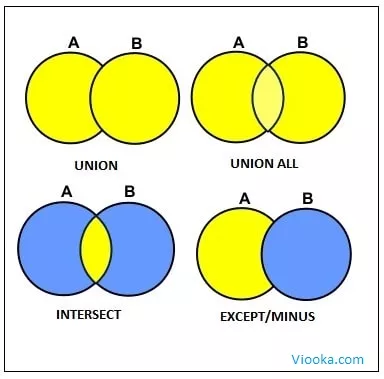
What is the difference among UNION , MINUS and INTERSECT ?
- SQL
Reveal answerHide answer
UNION combines the results from 2 tables and eliminates duplicate records from the result set. MINUS operator when used between 2 tables, gives us all the rows from the first table except the rows which are present in the second table. INTERSECT operator returns us only the matching or common rows between 2 result sets. https://viooka.com/wp-content/uploads/2022/04/Set-Operators-in-Redshift.webp
- Question 14Senior
Explain the difference between Exclusive Lock and Update Lock
- SQL Databases
Reveal answerHide answer
In case of Exclusive lock, no other lock can be acquired on that row or table. Every process has to wait until the process which holds the lock releases it. In case of Update lock, while reading the row or a record, you can have any other lock associated with that row or record. In case of updating the record, update lock changes itself to an exclusive lock and no other process can obtain a lock on that row until the lock is released.
- Question 16Senior
How to generate row number in SQL without ROWNUM
- SQL
Reveal answerHide answer
Consider: SELECT name, sal, (SELECT COUNT(*) FROM EMPLOYEE i WHERE o.name >= i.name) row_num FROM EMPLOYEE o order by row_num
- Question 17Senior
How can we transpose a table using SQL (changing rows to column or vice-versa)?
- SQL
Reveal answerHide answer
A transposition is to rotate information from one row or column to another to change the data layout, for the purpose of making observations from a new perspective. Method 1: case when subquery + grouping & aggregation Select year, max(Q1) 'Q1', max(Q2) 'Q2', max (Q3) 'Q3', max (Q4) 'Q4'
from (
select year,

case when quarter = 'Q1' then amount end Q1,
case when quarter = 'Q2' then amount end Q2,
case when quarter = 'Q3' then amount end Q3,
case when quarter = 'Q4' then amount end Q4
from zz11
) t group by year;
Method 2: sum if + grouping & aggregation
SELECT year,
MAX(IF(quarter = 'Q1', amount, null)) AS 'Q1',
MAX (IF(quarter = 'Q2', amount, null)) AS 'Q2',
MAX (IF(quarter = 'Q3', amount, null)) AS 'Q3',
MAX (IF(quarter = 'Q4', amount, null)) AS 'Q4'
FROM zz11 GROUP BY year;
Other methods include WITH ROLLUP + grouping & aggregation and UNION + grouping & aggregation, etc. They are essentially the same: calculate the year value after grouping, and generate new columns Q1-Q4 through enumeration and their values through aggregation.