Quick answer
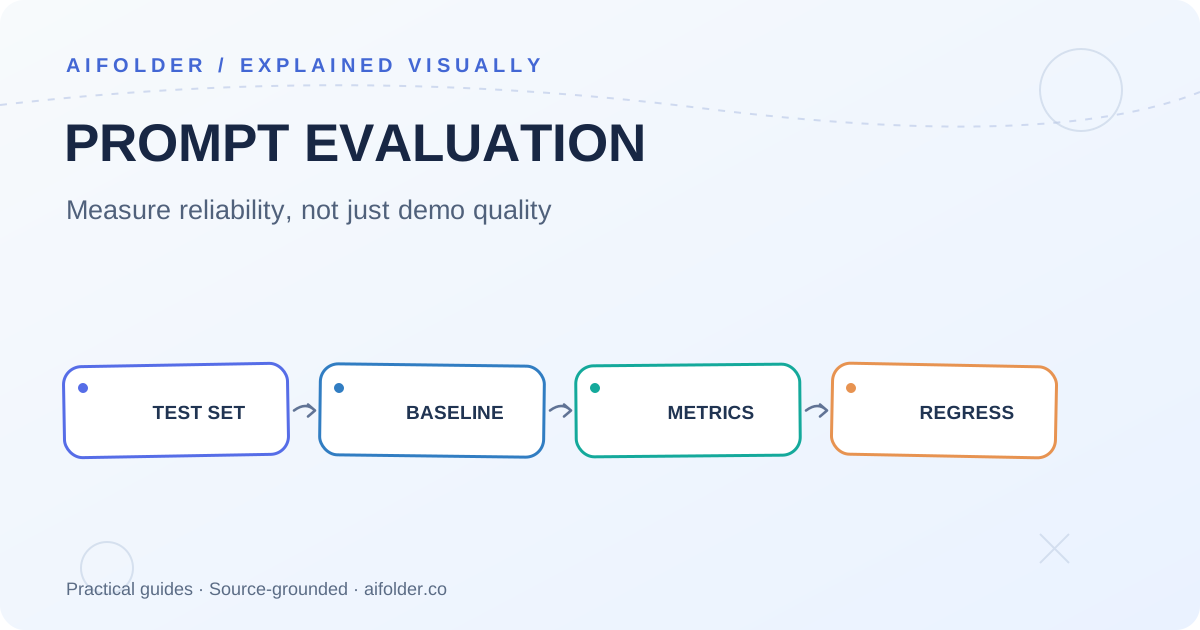
Prompt evaluation is the process of measuring whether an AI prompt produces outputs that meet a task's requirements over a representative set of inputs. It replaces guesswork with explicit criteria, tests, and repeatable comparisons. Quality is task-specific: a support classifier, JSON extractor, and creative writing assistant need different scorecards.
Why one good example is not enough
An AI model can answer a demonstration perfectly and still fail on spelling mistakes, unusual phrasing, missing information, or long context. If you tune prompts only by reading one or two outputs, you risk changing the wording in a way that improves the demo but harms real use cases.
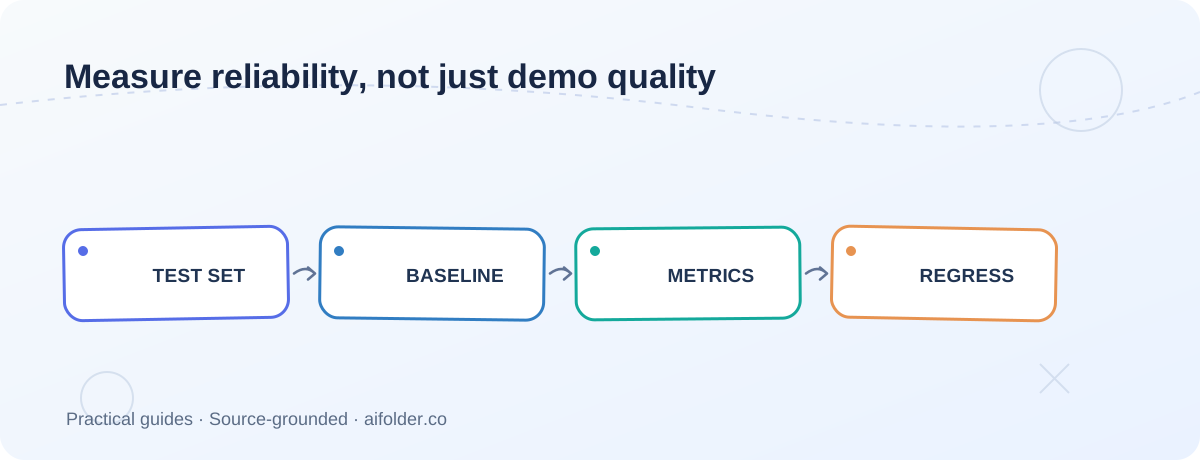
A practical evaluation loop consists of: define success, assemble examples, run prompt variants, score outputs, inspect failures, and retest after changes.
Step 1: Define the task and success criteria
Consider an assistant that extracts meeting action items. The expected output is a list containing task, owner, due date if explicitly mentioned, and the supporting source sentence.
Criteria might include:
- Completeness: Did it capture all explicit action items?
- Groundedness: Is every field supported by meeting notes?
- Format validity: Does the result match the required schema?
- Abstention: Does it leave owners and dates unknown when missing?
- Efficiency: What are the latency and token cost per run?
Not all metrics deserve the same weight. If inventing a deadline is especially harmful, unsupported dates may be an automatic failure even if the rest of the answer looks fluent.
Step 2: Build a small golden dataset
Create a dataset of 20–50 representative examples to start. Include short, long, ambiguous, multilingual, and noisy inputs when those are real user cases. Each example needs an input and a trusted expected answer or grading criteria.
An example record:
{
  "input": "Mina will review the draft by Friday. The launch date is still undecided.",
  "expected": [
    { "task": "review the draft", "owner": "Mina", "due": "Friday" }
  ]
}
Relative dates should be interpreted only when a reference date is explicitly available. Otherwise preserve the original phrase instead of inventing a calendar date.
Step 3: Score objectively where possible
Use programmatic checks for parseable JSON, allowed labels, required keys, and obvious exact-match tasks. For nuanced output, create a rubric with criteria and explicit rating anchors. Human review matters for factuality, user experience, and subtle failures.
An LLM judge can help triage candidates, but it can be inconsistent or biased toward fluent writing. Calibrate it against manually reviewed examples; do not treat the judge score as ground truth.
Step 4: Compare prompt variants fairly
Keep the dataset, model configuration, and test conditions consistent. Run the same inputs against a baseline and a candidate prompt. Track success rate, severe failure count, cost, and latency. If the model is nondeterministic, repeat enough cases to understand output variability.
A simple rubric:
<table header-row="true">
<tr>
<td>Metric</td>
<td>Pass condition</td>
</tr>
<tr>
<td>Valid format</td>
<td>Output parses and matches schema</td>
</tr>
<tr>
<td>Evidence</td>
<td>Each extracted item is backed by input</td>
</tr>
<tr>
<td>No fabricated dates</td>
<td>Missing dates remain unknown</td>
</tr>
<tr>
<td>Useful coverage</td>
<td>No obvious explicit action omitted</td>
</tr>
</table>
Step 5: Turn failures into regression tests
If a new prompt introduces an unsupported deadline, keep that input as a regression case. Record the prompt version, model identifier, dataset version, and scoring logic. This turns prompt changes into reviewable engineering decisions rather than undocumented edits.
Common mistakes
- Using test cases that also appeared as few-shot demonstrations.
- Optimizing only for one average score while ignoring severe mistakes.
- Claiming a model is better without controlling evaluation conditions.
- Treating non-deterministic answers as stable without reruns.
- Logging sensitive raw user data unnecessarily.
FAQ
Do I need a large evaluation platform?
No. A CSV or JSONL dataset plus a small script and a manual scoring sheet can work for the first iteration.
Can a model grade its own response?
It can provide a useful signal, but use objective checks and human calibration for important decisions.
What should I measure first?
Choose the failure mode most damaging to your users, and define a direct test for it.
Further reading
Explore related guides in AiFolder Blog and browse AI tools and resources.