Quick answer
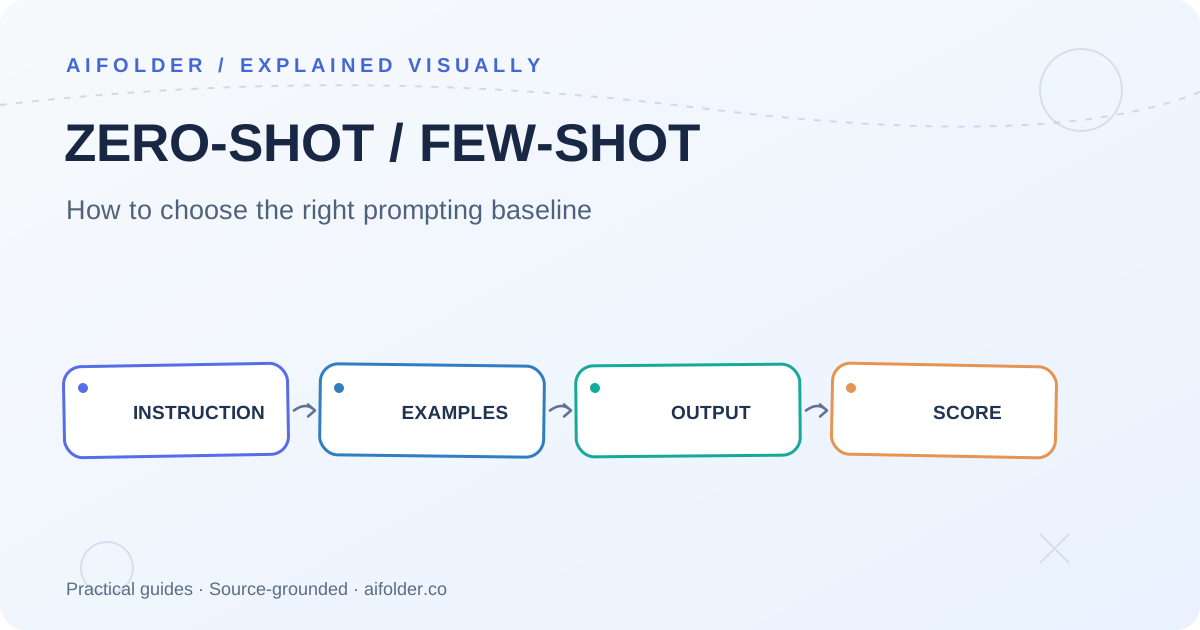
Zero-shot prompting tells an AI model what to do without showing it an example. Few-shot prompting shows the model example inputs and expected outputs before asking it to process the new input. Start with zero-shot for straightforward tasks; try few-shot when you need a particular labeling convention, style, or structure and a direct instruction performs inconsistently.
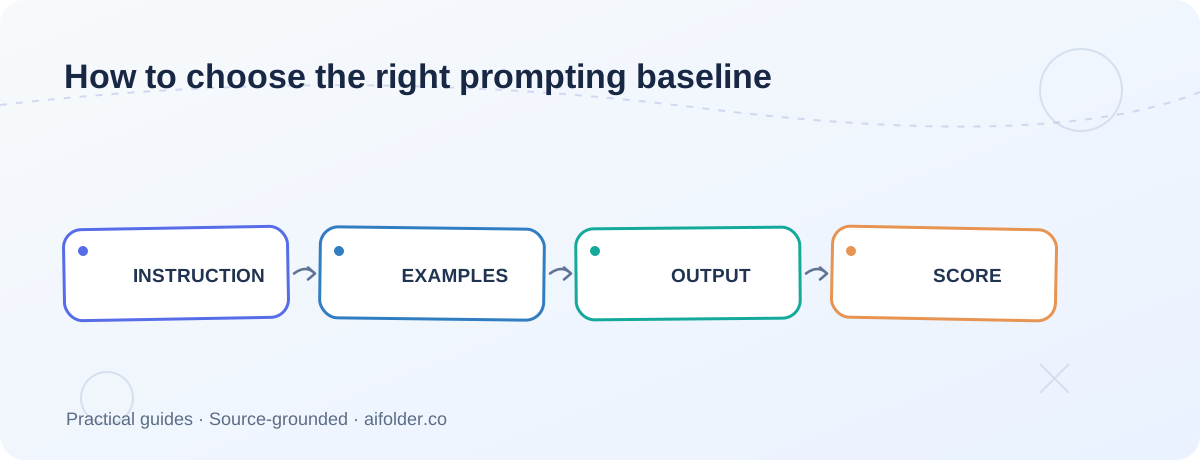
Same task, two prompts
Imagine a small support team routing messages to Billing, Technical, or Other.
Zero-shot version
Classify the customer message into Billing, Technical, or Other.
Return only the category.
Message: I was billed twice for my subscription.
The instruction is compact and easy to maintain. It is a sensible baseline if the category definitions are obvious and the model already understands them.
Few-shot version
Assign one of these labels: Billing, Technical, Other.
Examples:
Message: My invoice has the wrong amount.
Label: Billing
Message: The app crashes when I upload a file.
Label: Technical
Message: Can I change the company name in my profile?
Label: Other

Now classify:
Message: I was billed twice for my subscription.
Label:
The second prompt demonstrates the output convention. It may help when tasks have ambiguous categories or domain-specific labels, but its examples introduce extra tokens and possible bias.
Decision table
<table header-row="true">
<tr>
<td>Situation</td>
<td>Prefer</td>
<td>Why</td>
</tr>
<tr>
<td>Simple factual or well-defined request</td>
<td>Zero-shot</td>
<td>Low overhead</td>
</tr>
<tr>
<td>Custom output conventions</td>
<td>Few-shot</td>
<td>Examples clarify pattern</td>
</tr>
<tr>
<td>Long open-ended writing</td>
<td>Test both</td>
<td>Examples can constrain style too much</td>
</tr>
<tr>
<td>Highly constrained production classifier</td>
<td>Measure both</td>
<td>Accuracy, cost and reliability matter</td>
</tr>
</table>
How to choose good few-shot examples
Use examples that clarify decision boundaries rather than repeating the easy cases. If you classify support messages, include edge cases: billing-related access problems, technical complaints mentioning refunds, and vague customer requests. Avoid examples containing private real customer data unless you have a lawful and secure reason to use them.
Keep the output labels consistent. If every example uses a different structure, the model may reproduce that inconsistency. When the inputs vary widely, include diverse examples rather than cherry-picking one narrow style.
A tiny evaluation plan
Create 20 manually labeled messages spanning normal and ambiguous cases. Run each message through both approaches with the same underlying model and settings. Compare classification accuracy, malformed outputs, response latency, and approximate token cost. Keep the evaluation examples separate from the prompt demonstrations.
Do not claim few-shot always wins: newer models, task wording, example selection, and output schemas change the result.
What about one-shot, chain-of-thought, and prompt chaining?
One-shot is simply the special case with one demonstration. Chain-of-thought refers to reasoning-oriented prompting, and prompt chaining separates a larger job into multiple steps. These solve different problems: demonstrations teach output patterns, whereas chaining organizes a workflow.
Pitfalls
- Example leakage: Putting desired answers to your test set in the prompt can make the comparison misleading.
- Skewed demonstrations: Using only positive cases can weaken negative classification.
- Ignoring token cost: Each example adds repeated input and latency.
- No schema validation: Labels need application-side checking.
- Assuming universal gains: The correct technique depends on task and model.
FAQ
How many examples should I include?
Use the smallest useful set and expand only when evaluation supports it. There is no universal number.
Is zero-shot the same as giving no instructions?
No. The task itself is an instruction. 'Zero-shot' only means there are no example demonstrations.
Should few-shot examples be in the system message?
Stable examples may be part of application instructions; dynamic task data should generally be separated. Follow the messaging conventions of your chosen model/API.
Sources
Explore related guides in AiFolder Blog and browse AI tools and resources.