
Qualcomm introduced Snapdragon 8 Elite Extreme Gen 6 and Snapdragon 8 Elite Gen 6 as two flagship platforms. A chipset announcement tells you what a platform supports; it does not establish how a particular phone behaves under a sustained workload.
Shared foundation, distinct positioning
Qualcomm's AI overview identifies a shared foundation: Oryon CPU, Adreno GPU, Hexagon NPU, X105 modem and FastConnect 8800 connectivity. It positions Extreme at the top end. The announcement confirms the two-platform lineup.
This article does not publish an independent speed, battery or AI benchmark. We have not tested phones containing either platform. A shared component family also does not imply every shipping configuration has identical performance.
A platform is a set of capabilities; a phone is the implementation
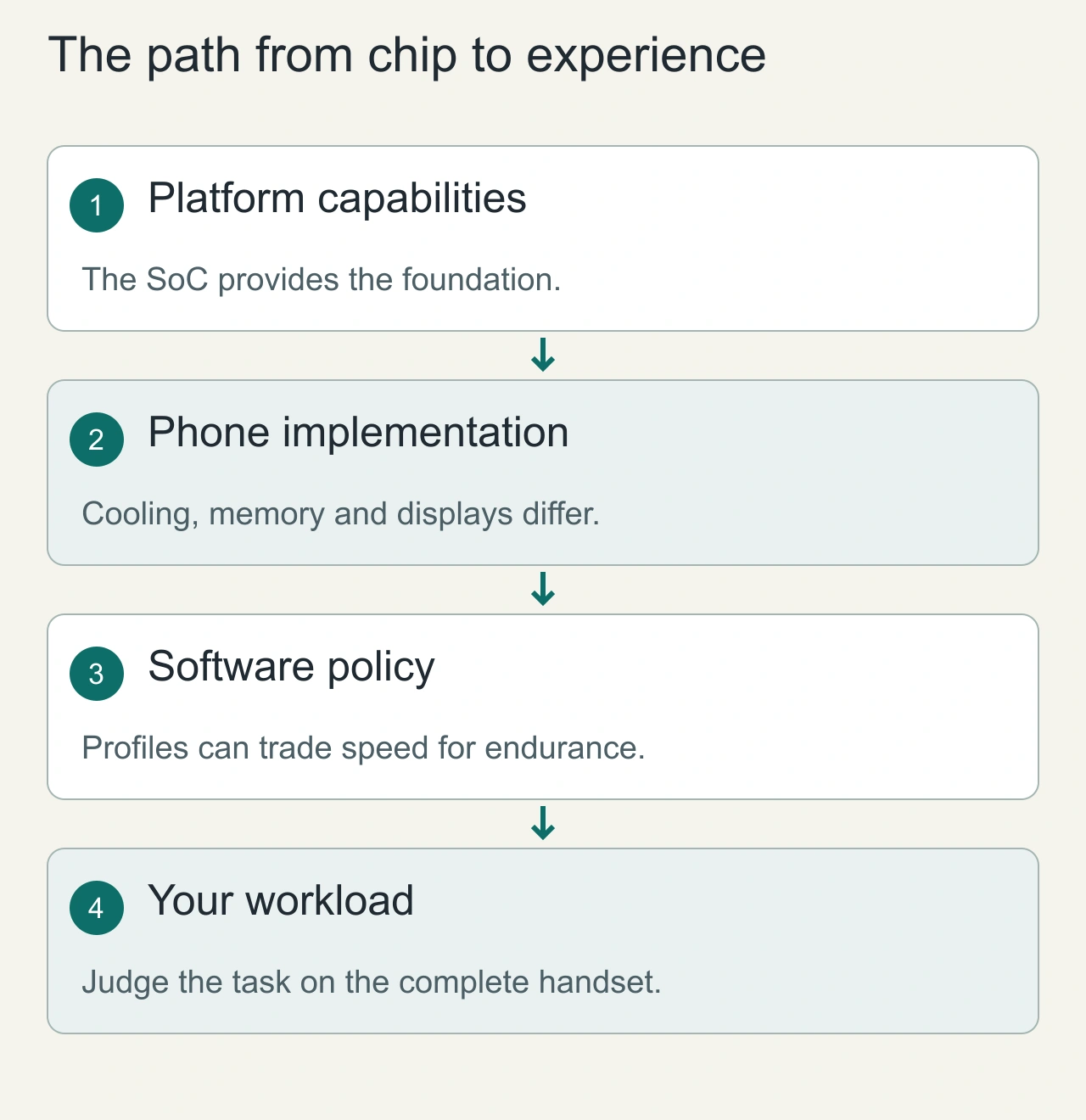
The same class of silicon can appear in devices that behave differently under sustained work. The phone manufacturer chooses the cooling arrangement, memory configuration, battery, display and software policy around the platform. Those choices affect how much work the device can keep doing after the first brief burst. A chip name is therefore a useful description of the foundation, not a complete phone review.
Consider two phones running the same game. One may use a larger display resolution or a different quality preset; another may prioritise battery use with a different performance profile. A comparison that ignores those choices can turn a settings difference into a misleading silicon ranking. Record the game version, rendering mode and device profile before interpreting the result.
Qualcomm’s current platform descriptions establish the positioning of the two products. The buying question remains about the complete handset you can obtain. Confirm that the camera, connectivity, memory and sustained workload you need are implemented in that model, rather than assuming that every platform capability will appear unchanged in every phone.
A useful comparison separates burst, sustained and energy behaviour
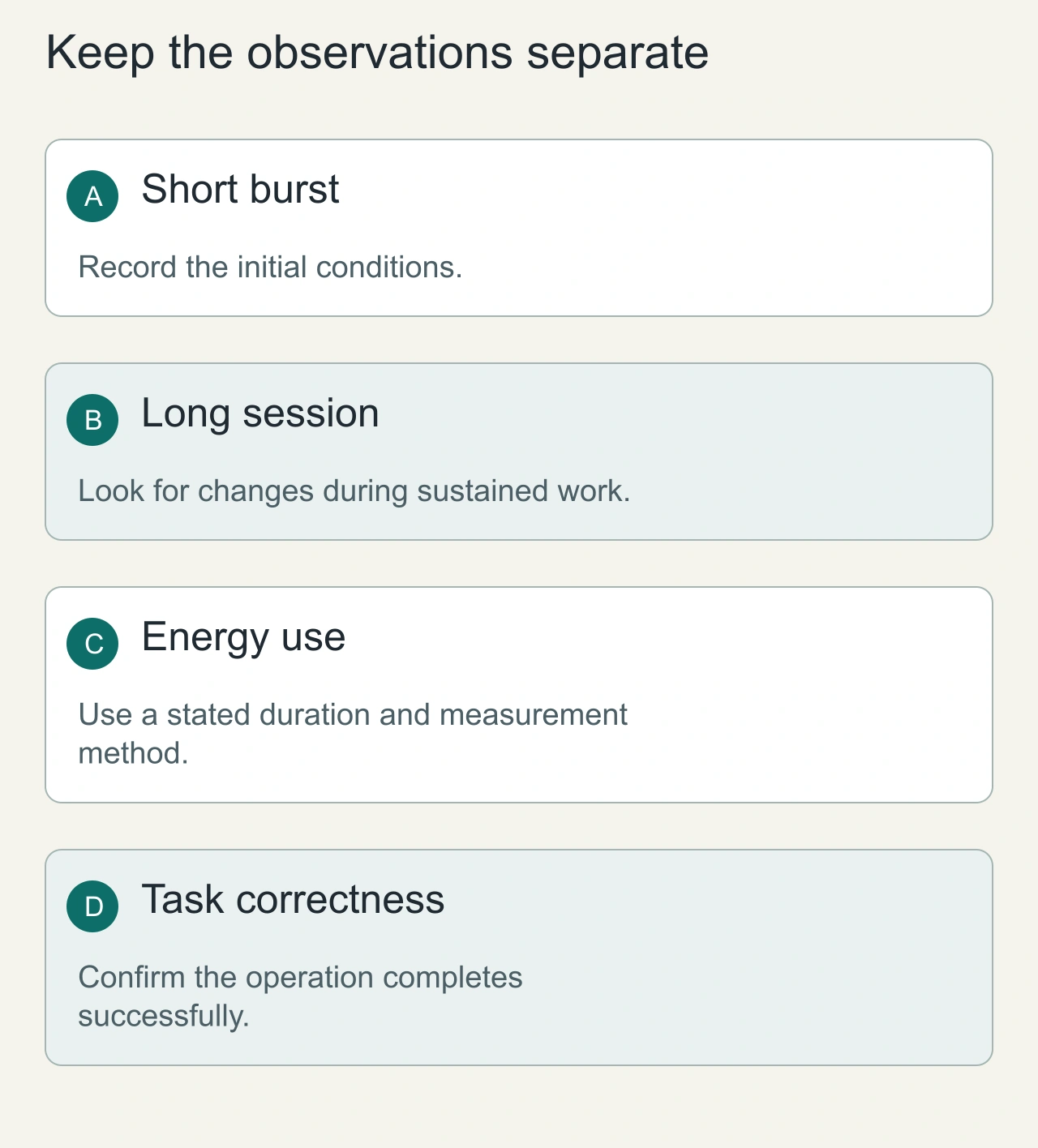
Begin with a task that matters to the owner: a game sequence, a video export or a supported on-device operation. Run the same inputs with the same application version and relevant settings. Keep starting conditions comparable and avoid comparing a cold first run on one device with a warmed-up later run on another.
For a long task, record progress over the session rather than only the fastest short interval. Note visible stutter, completion time, temperature warnings and the battery change over a known duration. If you use an external measurement tool, document what it can actually measure. A reported surface temperature is not automatically the chip temperature, and an application counter is not necessarily the display’s final delivered frame rate.
Use repeated runs to learn whether the conclusion survives ordinary variation. A small apparent lead in a noisy fixture may be less important than a clear difference in compatibility or comfortable handling. The worksheet can remain blank until the devices are available; invented numbers would make it less useful than an honest protocol.
Compare the complete phone
| Layer | Evidence to request |
|---|---|
| Compute | Exact platform and supported configuration |
| Memory | Installed RAM and the workload's usable budget |
| Cooling | Sustained behaviour in the shipping enclosure |
| Camera | Sensor and app support for the advertised capture mode |
| Network | Carrier availability and the phone's enabled bands |
| AI | Actual model, precision, context and execution location |
A modem's peak rate is not a forecast for your mobile plan. A capture capability does not guarantee a manufacturer exposes that mode in every camera. An AI marketing demonstration is incomplete without its model, memory and power conditions.
Design a useful comparison
Use the same app and version, ambient temperature, brightness and connection. Record battery state and whether the phone is plugged in. Repeat after cooling and include a sustained run. Report failures and thermal changes along with the median result rather than selecting the best short burst.
For local AI, verify inference stays on device and record model size, quantization, prompt length, generated tokens and time to first token. Keep loading time separate from steady generation. A smaller model on one phone is not a fair speed comparison against a larger model on the other.
Buying implication
Pay for a specific capability you can verify in the actual device. If neither phone has independent measurements for your workload, treat the performance question as unresolved. The platform name is a useful starting filter, while cooling, software and price determine the purchase.
Do not buy a theoretical capability you cannot demonstrate
A platform announcement may describe a maximum recording mode, network capability or accelerator feature that depends on the manufacturer’s implementation and application support. The meaningful confirmation is a demonstration on the exact handset and software version being sold. A specification attached to the silicon does not prove that the camera app exposes the same setting.
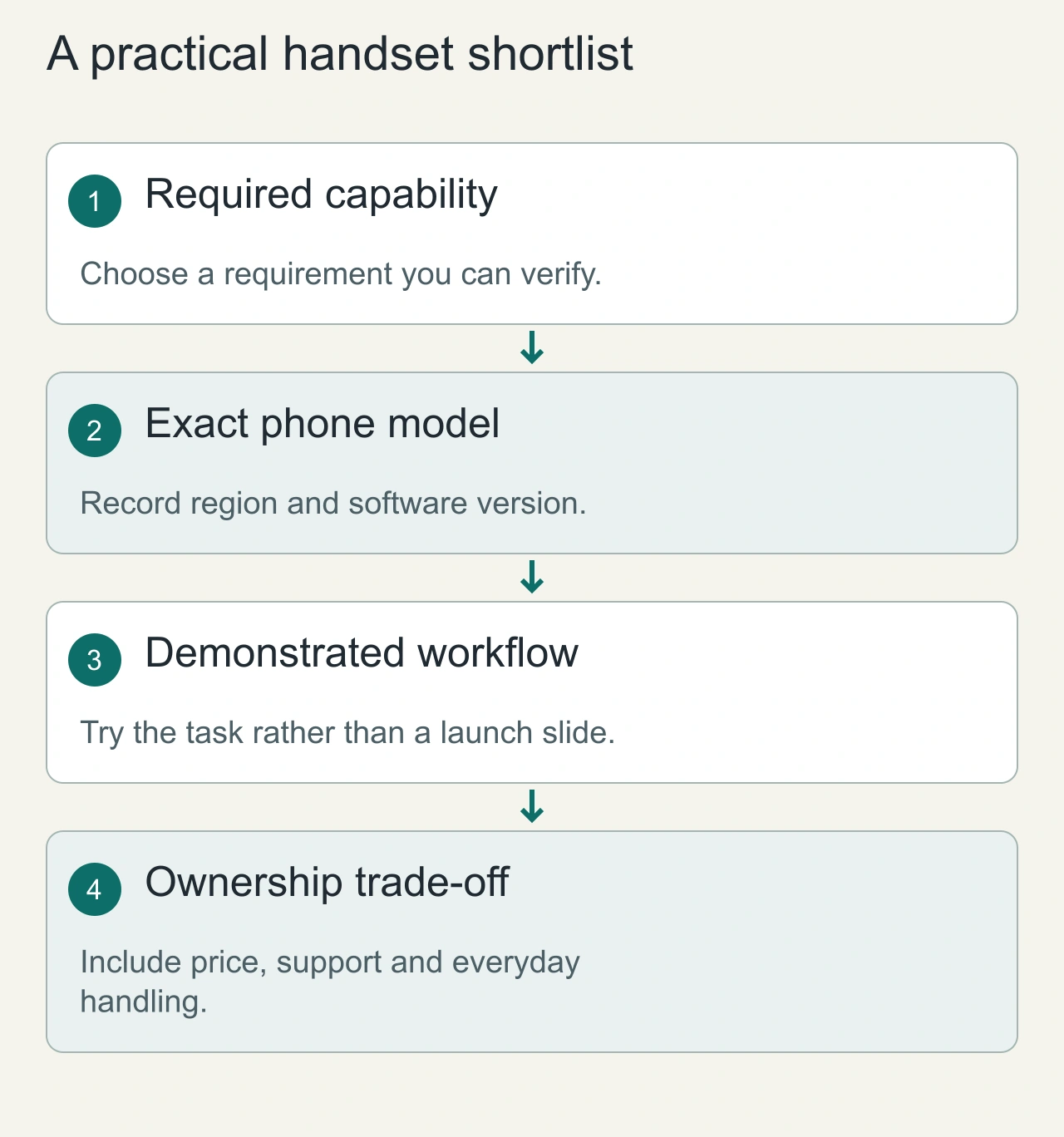
Make a short list of non-negotiable requirements and ask for evidence of each. For a gaming phone, that might include the specific title and controller workflow. For a creator, it might be the recording format and how the resulting file enters the editing application. For a traveller, local network compatibility and service arrangements can matter more than an untested benchmark advantage.
The platform tier helps narrow the shortlist. It should not replace the rest of the evaluation. Prefer a phone whose useful behaviour is documented and repeatable over a phone justified entirely by a name. This guide compares the decision process and official platform framing; it does not report AiFolder handset benchmarks.